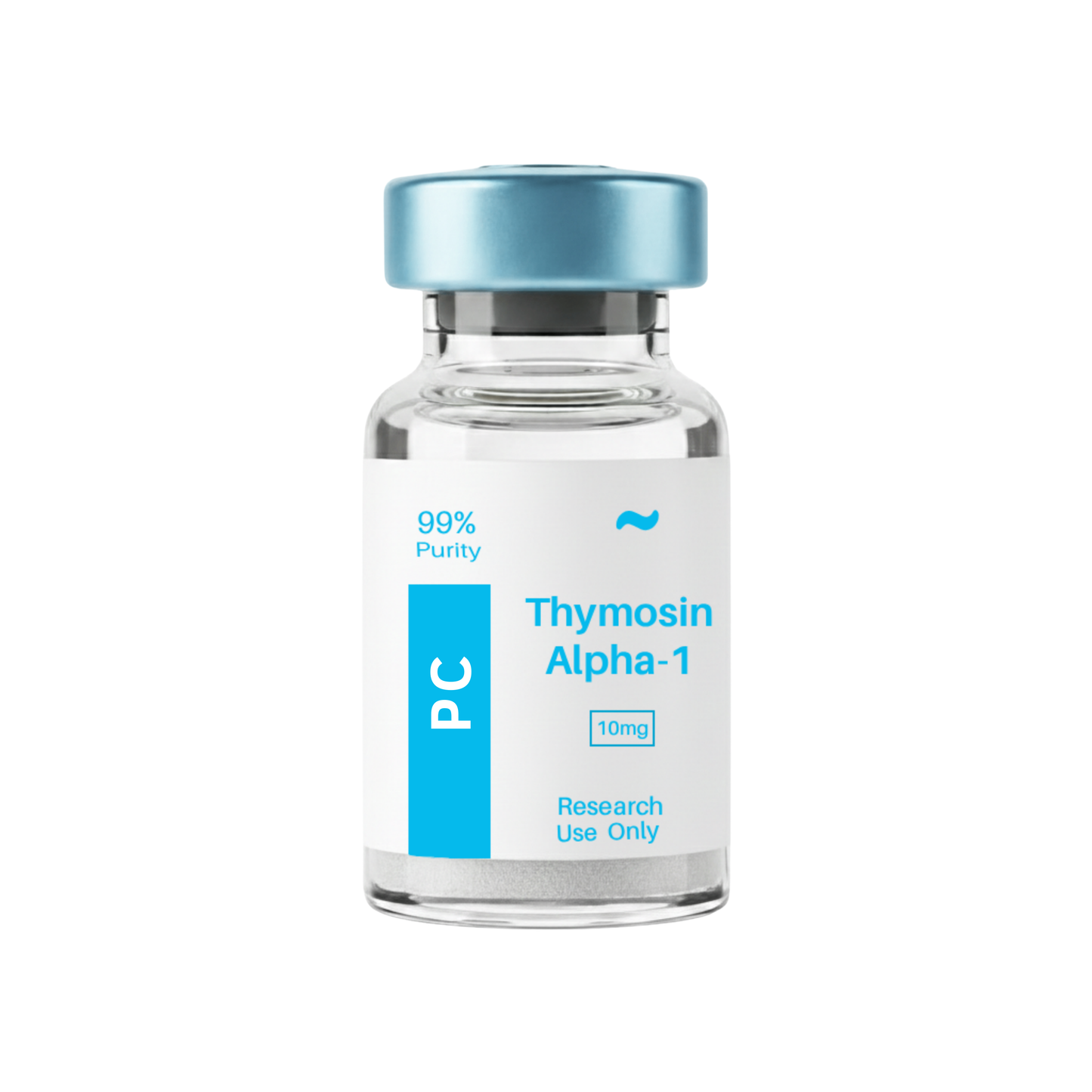
Thymosin Alpha-1
Thymosin Alpha-1
This batch of Thymosin Alpha-1 Peptide has been third party lab tested and verified for quality.
Contents: Thymosin Alpha
Form: Powder
Purity: 99.0%
Couldn't load pickup availability
Free Reconstitution Solution automatically added to your cart with each order.
| Made & Shipped From Canada
Verified+

Thymosin Alpha-1 Peptide
Thymosin Alpha-1 (Talpha1) is an endogenous, acetylated 28-amino acid polypeptide that was first isolated from the thymus gland in 1972. It is characterized by its powerful immunomodulatory effects, which influence the maturation and function of T-cells and the overall coordination of the immune response. Talpha1 has been the subject of extensive investigation for its potential therapeutic applications across numerous disease states, including chronic viral infections (Hepatitis B and C), various forms of cancer, sepsis, and neurodevelopmental disorders. Talpha1 is currently approved for pharmaceutical use in over 35 countries worldwide, primarily for the treatment of chronic hepatitis B and C infections.
Thymosin Alpha-1 Peptide Overview
The mechanism of action for Thymosin Alpha-1 (Talpha1) is thought to involve the activation of key immune receptors. It is hypothesized that Talpha1 binds to Toll-Like Receptors (TLRs), particularly those found on antigen-presenting cells (APCs) like dendritic cells. This interaction is believed to stimulate the systemic release of potent cytokines, most notably Interleukin-2 (IL-2) and Interferon-gamma (IFN-gamma). These cytokines are crucial for the development of adaptive immunity, enhancing the proliferation and functional capacity of key immune effectors, including T lymphocytes and Natural Killer (NK) cells.
Furthermore, research indicates that Talpha1 enhances the efficiency of antigen presentation by dendritic cells, which facilitates a rapid and precise immune system response against foreign antigens. Experimental evidence also supports the peptide's role in promoting immune homeostasis by helping to balance the profile of pro-inflammatory and anti-inflammatory signaling molecules.
Thymosin Alpha-1 Peptide Structure3
Thymosin Alpha-1 is a linear polypeptide chain comprising 28 amino acids. Its empirical formula is C129H215N35O43, and its structure exhibits high conservation across mammalian species.4
Amino Acid Sequence:5 Ac-Ser-Asp-Ala-Ala-Val-Asp-Thr-Ser-Ser-Glu-Ile-Thr-Thr-Lys-Asp-Leu-Lys-Glu-Lys-Lys-Glu-Val-Val-Glu-Glu-Ala-Glu-Asn-OH
Molecular Weight: 3108.31 Da
IUPAC Name (Formula): N-[ (N-acetyl-L-seryl)-L-alpha-aspartyl-L-alanyl-L-alanyl-L-valyl-L-alpha-aspartyl-L-threonyl-L-seryl-L-seryl-L-alpha-glutamyl-L-isoleucyl-L-threonyl-L-threonyl-L-lysyl-L-alpha-aspartyl-L-leucyl-L-lysyl-L-alpha-glutamyl-L-lysyl-L-lysyl-L-alpha-glutamyl-L-valyl-L-valyl-L-alpha-glutamyl-L-alpha-glutamyl-L-alanyl-L-alpha-glutamyl]-L-asparagine
Thymosin Alpha-1 Research
Thymosin Alpha-1 and Its Role in Immune Modulation
Originating from the thymus gland, Talpha1 is a fundamental regulator of immune system function. The thymus is essential for the maturation of T-cells, which are the specialized lymphocytes that underpin the adaptive immune system by providing targeted defense and long-term immunological memory.
In studies using animal models with compromised immune systems, Talpha1 administration was shown to partially restore immune competence and provide protection against systemic infection. This effect is achieved by activating crucial signaling pathways and stimulating the controlled release of cytokines that effectively coordinate the function and communication of immune cells.
Research Focus
Key Biological Activity and Observed Results
Clinical Application / Status
Hepatitis B & C
Direct antiviral properties; potent immune booster for viral vaccines.
Approved clinical use in numerous countries.
Cancer Research
Anti-proliferative effects; enhances effects of chemotherapy agents (synergistic).
Being studied for combination therapy and cancer vaccine potential.
Sepsis
Controls the host's destructive hyper-inflammatory response (cytokine storm).
Highly promising candidate for adjunctive therapy in critical care.
Infectious Diseases
Improves immune defense against fungal (e.g., Aspergillus) and other pathogens.
Potential adjunct to various antimicrobial treatments.
Inflammatory Pain
Exerts strong anti-inflammatory effects by reducing pro-inflammatory cytokines.
Explored as a mechanism-specific alternative for pain management.
Talpha1's role as a vaccine adjuvant is a major research area. By significantly enhancing the immune response generated by traditional inactivated vaccines, Talpha1 may help overcome their limitation of generating weaker, less durable immunity, potentially leading to stronger and longer-lasting protection.
The peptide's immunomodulatory capabilities are also crucial in sepsis research. Sepsis is characterized by an excessive and life-threatening immune response. Talpha1 may help mitigate this pathological overreaction, thereby reducing the risk of organ damage and improving patient survival outcomes.
Thymosin Alpha-1 Encourages Neural Growth
Research indicates a strong connection between Talpha1 and the central nervous system (CNS). Talpha1 has been suggested as a significant enhancer of neurodevelopment. Studies have linked peripheral administration of the peptide with improved cognitive performance in animal models. Mechanistically, Talpha1 is hypothesized to influence genes related to neuron growth and synaptic connection formation. Crucially, it promotes a neural environment that supports development while simultaneously inhibiting inflammatory pathways associated with neuronal dysfunction. These findings highlight Talpha1's potential relevance to neurodevelopmental disorders.
Thymosin Alpha-1 and Fungal Infections
Dendritic cells (DCs) are sentinel immune cells essential for identifying and mounting a response against fungal pathogens. Talpha1 has been shown to promote the maturation and activation of these dendritic cells, significantly bolstering the immune system's antifungal defense. In models of Aspergillus infection, Talpha1 was also shown to activate T-helper cells. This mechanism supports the investigation of Talpha1 as an adjunct therapy to improve the effectiveness of conventional antifungal agents.
Thymosin Alpha-1 and Hepatitis
Talpha1 is an established and accessible therapeutic option for chronic hepatitis B and C in many countries. Its clinical benefits include a potential direct antiviral effect and a robust immune-enhancing role, used effectively to boost the efficacy of related vaccines.
Thymosin Alpha-1 and HIV
Despite effective viral suppression through antiretroviral therapy (ART), many individuals with HIV experience incomplete immune reconstitution and chronic inflammation. Talpha1 research suggests it could help restore immune balance and improve the quality of life for those undergoing HAART. It is believed to activate CD8 T-cells, which subsequently release factors that block HIV infection in other immune cells and prevent the reactivation of latent HIV reservoirs.
Thymosin Alpha-1 Research and Blood Pressure
Recent studies suggest Talpha1 may act as an inhibitor of the Angiotensin-Converting Enzyme (ACE), a vital enzyme in the regulation of blood pressure. By blocking ACE, Talpha1 could contribute to blood pressure reduction, similar to prescribed ACE-inhibiting drugs. Talpha1 may offer comparable cardiovascular benefitsβsuch as vascular relaxation, reduced cardiac remodeling, and improved kidney functionβwith a potentially reduced side-effect burden.
Thymosin Alpha-1 Research and Cancer
In studies involving human lung cancer cells, Talpha1 has demonstrated anti-proliferative properties, limiting the growth and dissemination of tumor cells. It also restricts cell migration, a critical step in preventing metastasis. Combination studies with the chemotherapy agent dacarbazine showed enhanced progression-free survival without increasing toxicity, indicating a synergistic effect. Talpha1's immunoregulatory function supports research into its use in developing cancer vaccines.
A modified, long-acting Talpha1 analogue demonstrated superior efficacy in slowing tumor growth in mouse models of breast cancer. This was correlated with elevated counts of CD4 and CD8 T-cells and increased levels of key immune molecules like IFN-gamma and IL-2. Talpha1 is an active research area for treating:
- Breast cancer
- Melanoma
- Liver cancer
- Lung cancer
- Colon cancer
Thymosin Alpha-1 Research and Inflammatory Pain
Given its established anti-inflammatory properties, Talpha1 is being investigated for its potential to treat inflammatory pain. Studies in mice suggest Talpha1 can alleviate pain by interfering with key inflammatory signaling pathways. It acts locally to reduce the production of pro-inflammatory cytokines such as TNF-alpha and IL-1 beta, offering a distinct, mechanism-specific approach to pain management.
Thymosin Alpha-1 and Cystic Fibrosis
A central pathological feature of Cystic Fibrosis (CF) is chronic inflammation coupled with the dysfunction of the CFTR protein. Research suggests Talpha1 may reduce this inflammation and potentially enhance the proper function of the CFTR protein. This supports Talpha1's potential as a therapeutic option for CF.
Damaged Teeth and Thymosin Alpha-1
Studies on avulsed (knocked-out) and replanted permanent teeth suggest Talpha1 can promote the healing of surrounding soft tissues and improve the survival rate of the replanted tooth. These findings support Talpha1's potential as a beneficial adjunct in the management of traumatic dental injuries.
The Future of Thymosin Alpha-1
Building upon its status as an approved medical therapy in various countries, the vast research potential of Talpha1 continues to be explored. Future efforts are focused on optimizing its delivery, enhancing its potency, and refining synthesis methods. Modified, long-acting versions of Talpha1 are highly anticipated for expanded clinical trials across a wide range of diseases. Talpha1 remains a highly promising agent for immune system regulation, consistently demonstrating a high safety profile and low toxicity in studies.
STORAGE
Storage Instructions
All products are prepared via lyophilization (freeze-drying), a process that guarantees product stability during shipping for approximately 3β4 months.
Lyophilization, or cryodesiccation, is a specialized process involving freezing the peptide and then removing water by sublimation (solid to gas transition) under vacuum. This yields a stable, white crystalline structureβthe lyophilized peptideβwhich maintains its integrity at room temperature until reconstitution.
Once reconstituted with bacteriostatic water or an equivalent solvent, peptide solutions must be refrigerated to maintain efficacy. Most reconstituted solutions remain stable for up to 30 days under proper refrigeration.
Best Practices For Storing Peptides
Strict adherence to storage protocols is essential for ensuring the integrity, stability, and reliability of research peptides, minimizing the risk of contamination, oxidation, and degradation.
- Upon Receipt: Peptides must be stored in a cool, light-protected environment.
- Short-Term Storage (Days to Months): Refrigeration at or below 4 degrees C (39 degrees F) is appropriate. Lyophilized forms can tolerate room temperature for several weeks, which is acceptable for short-term use.
- Long-Term Storage (Months to Years): For optimal preservation of structural integrity and stability over extended periods, peptides should be stored in a freezer at -80 degrees C (-112 degrees F).
Preventing Oxidation and Moisture Contamination
Exposure to air and moisture must be minimized. Moisture contamination is a key risk when retrieving a cold vial from the freezer. To prevent condensation from forming on the peptide, always allow the vial to reach room temperature before opening the container.
Minimize air exposure by keeping the container sealed whenever possible. After the required sample is removed, promptly reseal the container. Storing the remaining material under a dry, inert gas atmosphere (e.g., nitrogen or argon) can further mitigate oxidation. Peptides containing cysteine (C), methionine (M), or tryptophan (W) residues are particularly susceptible to air oxidation.
To preserve long-term stability, minimize freeze-thaw cycles. It is best practice to divide the total peptide quantity into smaller aliquots, each designated for a single experiment.
Storing Peptides In Solution
Peptide solutions have a significantly shorter shelf life and are more susceptible to degradation. Peptides containing residues such as cysteine (Cys), methionine (Met), tryptophan (Trp), aspartic acid (Asp), glutamine (Gln), or N-terminal glutamic acid (Glu) are known to degrade more rapidly when in solution.
If liquid storage is required, use sterile buffers with a pH between 5 and 6. The solution must be aliquoted to minimize freeze-thaw cycles. Most peptide solutions remain stable under refrigeration at 4 degrees C (39 degrees F) for up to 30 days, but less stable peptides should be frozen when not in immediate use.
Peptide Storage Containers
Containers must be clean, durable, chemically resistant, and sized appropriately. Both glass and plastic vials are suitable, with high-quality glass vials offering superior chemical inertness. Though peptides are often shipped in plastic, they can be transferred to glass or plastic containers as needed.
Peptide Storage Guidelines: General Tips
Ensure maximum stability and integrity by adhering to these guidelines:
- Store peptides in a cold, dry, and dark environment.
- Avoid repeated freeze-thaw cycles.
- Minimize exposure to air to reduce oxidation.
- Protect peptides from light exposure.
- Do not store peptides in solution long term; keep them lyophilized whenever possible.
- Aliquot peptides based on experimental needs to prevent unnecessary handling.
Reference Citations
Garaci E, Pica F, Serafino A, et al. Thymosin al and cancer: action on immune effector and tumor target cells. Ann NY Acad Sci. 2012;1269:26-32. https://doi.org/10.1111/j.1749-6632.2012.06735.x
Romani L, Bistoni F, Gaziano R, et al. Thymosin alpha 1 activates dendritic cells for antifungal Th1 resistance through toll-like receptor signaling. Blood. 2004;103(11):4232-4239. https://doi.org/10.1182/blood-2003-09-3099
King R, Tuthill C. Immune modulation with thymosin alpha 1 treatment. Vitam Horm. 2016;102:151-178. https://doi.org/10.1016/bs.vh.2016. 04.007
Ciabattini A, Pettini E, Medaglini D. Thymosin alpha 1 as immune adjuvant in therapeutic vaccines. Expert Opin Biol Ther. 2018;18(sup1):61-67. https://doi.org/10.1080/14712598.2018.1518214
Sherman KE, Sjogren MH, Creager RL, et al. Thymosin al and interferon for chronic hepatitis C: a randomized, placebo-controlled trial. Hepatology. 1998;27(4):1128-1135. https://pubmed.ncbi.nlm.nih.gov/9537447/
Cordero OJ, Salgado FJ, Vinuela JE, et al. Immune activation by thymosin alpha 1 in subjects with immunodeficiency. Int Immunopharmacol. 2001;1(12):1949-1959. https://doi.org/10.1016/S1567-5769(01)00139-1
Costantini C, Bellet MM, Pariano M, et al. A reappraisal of thymosin al in cancer therapy. Front Oncol. 2019;9:873. https://doi.org/10.338 9/fonc.2019.00873
Matteucci C, Grelli S, De Smaele E, et al. Thymosin alpha 1 and immune response: new insights and potential applications. Future Sci OA. 2017;3(3):FSO236. https://doi.org/10.4155/fsoa-2016-0089
ClinicalTrials.gov. Thymosin Alpha 1 in Immunodeficiency. https://clinicaltrials.gov/ct2/show/NCT00586981
Fabris N, Garaci E. Thymosin alpha 1 in immunotherapy. Methods Find Exp Clin Pharmacol. 1991;13(3):167-176. https://pubmed.ncbi.nlm. nih.gov/1886031/
Certificate of Analysis (COA): Lab report for this product purity, identity, and chromatograms.
Excellent 4.6 | Verified reviews
Tested. Verified. Trusted.
We take a laboratory-first approach to quality. Each batch is made under controlled conditions and verified by an independent lab (HPLC/MS). We only ship batches that test β₯99% purity, and we provide a full COA, including identity, methods, and chromatograms, for your review.
Shop now
-

FAST DELIVERY
Enjoy fast and reliable 3β5 day shipping.
-

HIGHEST QUALITY PEPTIDES
Our products are scientifically formulated and manufactured in cGMP-compliant facilities.
-

Dedicated Customer Service
Our customer service team is highly knowledgeable in peptide research and its applications. Weβre available 24/7 to assist you.