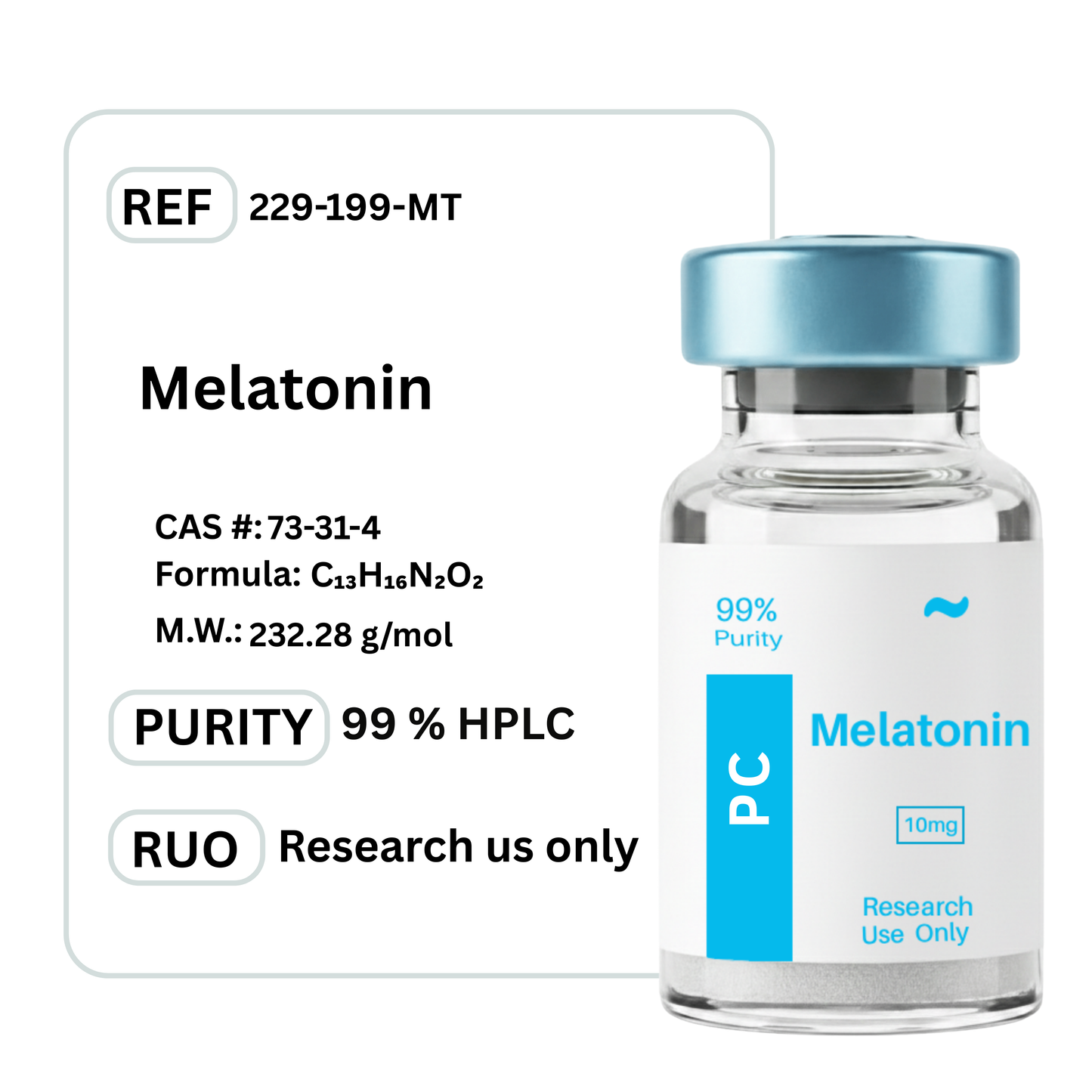
Melatonin
Melatonin (N-acetyl-5-methoxytryptamine) is an essential, naturally produced indoleamine synthesized primarily in the pineal gland. Its primary biological functions encompass the regulation of circadian rhythms, seasonal physiological timing, and the maintenance of systemic cellular defense systems. This high-quality compound is a standard reagent in scientific research focused on understanding sleep and chronobiology, cytoprotection mechanisms, and the complex interplay of neuroendocrine signaling. This material is produced and designated exclusively for laboratory and analytical research purposes.
Melatonin Overview
The biosynthesis of melatonin proceeds from the amino acid tryptophan through an enzymatic pathway that includes serotonin as a key intermediate. Its release into the circulation is tightly governed by the light-dark cycle, with concentration peaking during the darkness of night. Within experimental settings, melatonin functions as a multifunctional biological signal critical for coordinating circadian synchronization, promoting mitochondrial stability, regulating redox homeostasis, and fine-tuning immune system responses.
Further scientific investigation emphasizes melatonin’s profound role as a fundamental, endogenous antioxidant. It possesses the unique capability to directly neutralize various reactive oxygen and nitrogen species while concurrently promoting the expression and activity of protective enzymes, such as superoxide dismutase, catalase, and glutathione peroxidase. Melatonin is also extensively studied for its modulatory effects on reproductive endocrinology, its significant contribution to neuroprotective strategies, and its ability to slow pathways associated with cellular aging.
Melatonin Structure
Parameter
Value
Molecular Formula
C13H16N2O2
Molecular Weight
232.28 Da
Observed Mass (Batch # 2025027)
232.3 Da
High Purity (LCMS-confirmed)
99.17 %
Form
Crystalline powder
Analysis Method
Reverse-phase HPLC (UV 280 nm) and LCMS (ESI+ mode), calibrated with reference standard.
Appearance
White to faintly off-white crystalline powder
Melatonin Research
Circadian Rhythm and Sleep Regulation
Melatonin activates the MT1 and MT2 receptors located within the suprachiasmatic nucleus (SCN) of the hypothalamus, the brain's master biological clock. Studies demonstrate its ability to facilitate the phase-shifting and modulation of circadian rhythms, establishing it as a critical probe for advanced research in chronobiology and the fundamental mechanisms governing sleep physiology.
Antioxidant and Mitochondrial Effects
Melatonin exhibits powerful direct and indirect antioxidant properties. It effectively scavenges free radicals and dramatically enhances the activity and expression of native antioxidant enzymes. This dual protective action positions it as a foundational molecule in all research concerning oxidative stress damage and the critical maintenance of mitochondrial health and bioenergetics.
Neuroendocrine and Immune Modulation
The regulatory involvement of melatonin in both neuroendocrine signaling and the comprehensive immune response is a key research area. Findings indicate its function in balancing cytokine profiles, managing inflammatory processes, and exerting control over the entire hypothalamic–pituitary axis.
Cellular Protection and Aging
Research into the cytoprotective and anti-aging potential of melatonin highlights its ability to maintain mitochondrial integrity, stabilize the cell membrane potential, and actively limit the accumulation of DNA damage associated with senescence. Its broad anti-inflammatory and antioxidant actions make it a highly relevant focus for studies exploring cellular resilience and longevity.
Article Author
This literature review, editing, and content structure were executed by Dr. Russel J. Reiter, Ph.D., a renowned Professor of Cellular Biology at the University of Texas Health Science Center at San Antonio.
Dr. Reiter is universally acknowledged as a world-leading expert in melatonin biology. His groundbreaking research has systematically clarified melatonin’s multifaceted roles in circadian regulation, mitochondrial performance, antioxidant defense, and the processes of cellular aging. His extensive career has been instrumental in advancing the scientific understanding of melatonin as both a powerful neuroendocrine signal and an extraordinarily potent antioxidant.
Scientific Journal Author
The collaborative and influential investigations conducted by Dr. Russel J. Reiter, Dr. Dun-Xian Tan, and their research team have been absolutely critical in the detailed characterization of melatonin's broad biological properties.
Their collective scientific body of work has defined the molecular scope of melatonin’s actions, ranging from its receptor-mediated events to its deep involvement in redox balance and its role in mitochondrial protection. Through their ongoing contributions, the Reiter–Tan group has significantly advanced the core research fields of chronobiology, cellular energy dynamics, and physiological resilience, confirming melatonin’s status as a key molecule in physiological science.
Reference Citations
- Reiter RJ, Tan DX, Galano A. "Melatonin: exceeding expectations." Physiology (Bethesda). 2014;29(5):325-333. https://pubmed.ncbi.nlm.nih.gov/25180259/
- Hardeland R, Cardinali DP, Srinivasan V, et al. "Melatonin-a pleiotropic, orchestrating regulator molecule." Prog Neurobiol. 2011;93(3):350-384. https://pubmed.ncbi.nlm.nih.gov/21193011/
- Acuña-Castroviejo D, Escames G, Venegas C, et al. "Melatonin in the regulation of cellular energy metabolism: mitochondrial protection." Int J Mol Sci. 2014;15(4):6908-6938. https://pubmed.ncbi.nlm.nih.gov/24752558/
- Arendt J, Skene DJ. "Melatonin as a chronobiotic." Sleep Med Rev. 2005;9(1):25-39. https://pubmed.ncbi.nlm.nih.gov/15649736/
- Pandi-Perumal SR, Srinivasan V, Maestroni GJM, et al. "Melatonin: Nature's most versatile biological signal." FEBS J. 2006;273(13):2813-2838. https://pubmed.ncbi.nlm.nih.gov/16817850/
- Cardinali DP, Pevet P. "Basic aspects of melatonin action." Sleep Med Rev. 1998;2(3):175-190. https://pubmed.ncbi.nlm.nih.gov/15310406/
- Claustrat B, Leston J. "Melatonin: physiological effects in humans." Neurochirurgie. 2015;61(2-3):77-84. https://pubmed.ncbi.nlm.nih.gov/ 25818301/
- Tan DX, Manchester LC, Terron MP, et al. "Melatonin as a natural antioxidant: from molecular mechanisms to clinical significance." Brain Res Bull. 2007;73(1-3):203-213. https://pubmed.ncbi.nlm.nih.gov/17499606/
- Reiter RJ, Rosales-Corral S, Tan DX, et al. "Melatonin as a mitochondria-targeted antioxidant: one molecule, multiple actions." Cell Mol Life Sci. 2017;74(21):3863-3881. https://pubmed.ncbi.nlm.nih.gov/28567501/
- National Center for Biotechnology Information. "Melatonin compound summary," https://pubchem.ncbi.nlm.nih.gov/compound/Melatonin
ALL ARTICLES AND PRODUCT INFORMATION PROVIDED ON THIS WEBSITE ARE FOR INFORMATIONAL AND EDUCATIONAL PURPOSES ONLY.
The products offered on this website are furnished for in-vitro studies only. In-vitro studies (Latin: in glass) are performed outside of the body. These products are not medicines or drugs and have not been approved by the FDA to prevent, treat or cure any medical condition, ailment or disease. Bodily introduction of any kind into humans or animals is strictly forbidden by law.
STORAGE
Storage Instructions
This product is prepared using a lyophilization (freeze-drying) method, guaranteeing stability for approximately 3-4 months during shipping. After reconstitution with bacteriostatic water, the peptide solution must be refrigerated to maintain its efficacy, remaining stable for a period up to 30 days.
Lyophilization, or cryodesiccation, is a specialized dehydration process where peptides are frozen and subjected to low pressure, allowing water to sublime directly from solid to gas. This yields a stable, white crystalline powder—the lyophilized peptide. This powder is safe for room temperature storage for a duration until it is reconstituted for use.
For optimal long-term preservation (several months to years), storage in a freezer at -80 degrees C (-112 degrees F) is required. This ultra-low temperature ensures maximal structural integrity and long-term chemical stability.
Upon receipt, peptides must be kept cool and shielded from light. For short-term use, refrigeration below 4 degrees C (39 degrees F) is adequate. Lyophilized peptides are generally stable at room temperature for several weeks, acceptable for brief storage periods.
Best Practices For Storing Peptides
Proper storage is essential for maintaining the accuracy and reliability of research results. Correct protocols prevent contamination, minimize oxidation, and limit degradation, ensuring peptides remain effective. Adhering to these best practices significantly extends the peptide's lifespan and preserves its integrity.
- Short-Term Storage: Peptides must be kept cool and shielded from light. Refrigeration below 4 degrees C (39 degrees F) is standard.
- Long-Term Storage: Use a freezer set at -80 degrees C (-112 degrees F) for storage spanning months or years to achieve optimal stability.
- Avoid Freeze-Thaw Cycles: Minimize repeated freeze-thaw cycles rigorously, as this accelerates degradation. Avoid frost-free freezers due to their inherent temperature fluctuations.
- Aliquoting: Divide the total peptide into smaller, single-use aliquots to prevent repeated handling and temperature exposure, thus maintaining integrity.
Preventing Oxidation and Moisture Contamination
It is mandatory to protect peptides from air and moisture, both of which compromise stability. To prevent moisture (condensation) from forming on the cold material, always allow the sealed vial to reach room temperature before opening after removal from the freezer.
Minimize air exposure by keeping the container sealed whenever possible. Promptly reseal the container after removing the necessary material. Storing the remaining peptide under an inert gas atmosphere (e.g., nitrogen or argon) provides additional protection against oxidation, which is especially critical for peptides containing Cysteine (C), Methionine (M), or Tryptophan (W) residues.
Storing Peptides In Solution
Peptide solutions have a significantly shorter shelf life and are more vulnerable to degradation than lyophilized peptides. Peptides containing Cys, Met, Trp, Aspartic acid (Asp), Glutamine (Gln), or N-terminal Glutamic acid (Glu) are known to degrade faster in liquid storage.
If liquid storage is unavoidable, use sterile buffers with a pH between 5 and 6. Aliquot the solution to minimize freeze-thaw cycles. Most solutions are stable for up to 30 days under refrigeration at 4 degrees C (39 degrees F), but less stable peptides should be frozen when not in immediate use.
Peptide Storage Containers
Containers must be clean, durable, chemically resistant, and appropriately sized to minimize air space. High-quality glass vials offer the best combination of inertness and stability for storage, though plastic (polystyrene or polypropylene) is often used for shipping.
Peptide Storage Guidelines: General Tips
Follow these best practices for optimal stability:
- Store in a cold, dry, and dark environment.
- Minimize freeze-thaw cycles.
- Minimize air exposure.
- Protect from light.
- Store lyophilized whenever possible.
- Use aliquots to prevent unnecessary handling.