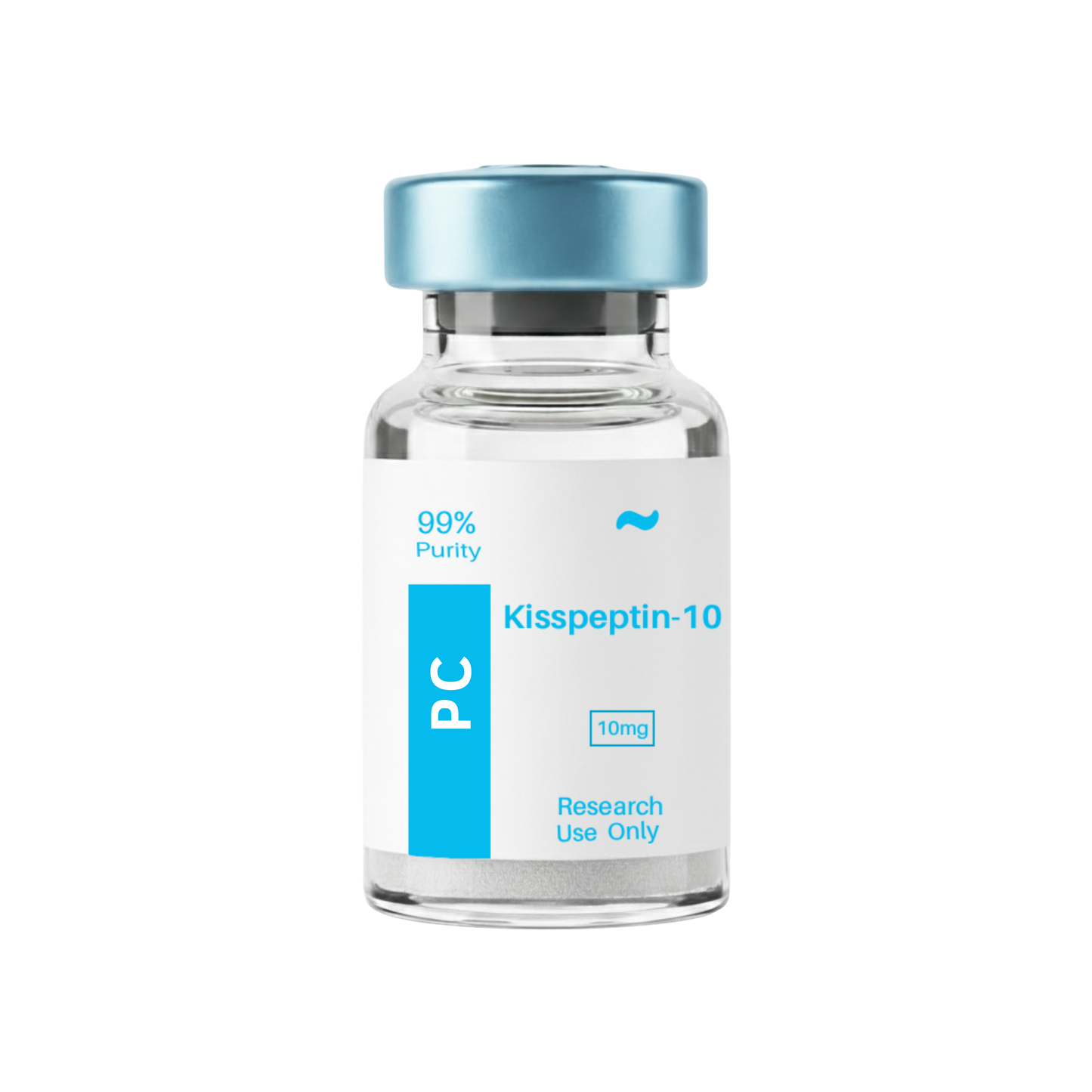
Kisspeptin-10 Peptide
Kisspeptin (also known as metastin) is a naturally occurring human protein crucial for orchestrating hormonal signaling related to puberty and reproduction. Beyond its primary endocrine role, it is believed to influence mood, behavior, support angiogenesis (the formation of new blood vessels), and contribute to kidney regulation. In the central nervous system, kisspeptin has demonstrated an ability to inhibit tumor growth and metastasis (the spread of cancer). The peptide's fundamental scientific importance lies in its ability to stimulate the release of gonadotropin-releasing hormone (GnRH).
Kisspeptin-10 Peptide - 5mg Overview
Kisspeptins are a family of neuropeptides derived from a larger precursor molecule. Kisspeptin-10 is recognized as the shortest form that remains biologically active. Its mechanism involves binding to the KISS1R receptor, which initiates the pulsatile release of GnRH from the hypothalamus. This action serves as the critical upstream regulator for the pituitary's secretion of luteinizing hormone (LH) and follicle-stimulating hormone (FSH).
Kisspeptin-10 is used extensively as a research reagent in studies focused on reproductive endocrinology, fertility control, neuroendocrine pathways, and cancer biology. Furthermore, its crucial function in bridging energy balance with reproductive capacity makes it a subject of metabolic and behavioral investigations.
Kisspeptin-10 Research
Boosting Gonadotropin-Releasing Hormone
GnRH is the foundational hormone of the hypothalamic-pituitary-gonadal (HPG) axis, produced by specialized neurons in the hypothalamus. It controls the release of FSH and LH from the anterior pituitary, which are essential for initiating puberty and governing the maturation of reproductive cells. Clinically, GnRH is a therapeutic tool for managing menstrual cycles, treating conditions like precocious puberty, and in the treatment of specific cancers.
Increasing Testosterone
Kisspeptin's influence on testosterone levels is mediated through its modulation of LH and FSH concentrations. This effect is pronounced in men, where research has shown it can significantly elevate testosterone, while the effect in women is negligible.
Research Observation in Males
Mechanism or Outcome
Intravenous derivative dose
Plasma testosterone levels nearly tripled within 90 minutes.
Kisspeptin-10 administration
Induces a rapid, dose-dependent rise in serum LH and corresponding testosterone.
Analog administration
Suggests regulation of the natural pulse frequency of LH secretion.
These findings suggest kisspeptin and its derivatives hold potential for managing conditions like male infertility and low testosterone (hypogonadism).
Energy Balance
Kisspeptin neurons are highly sensitive to an organism's nutritional and energy status. Both under- and over-nutrition can suppress the neurons' ability to trigger GnRH release, thus mediating infertility related to significant energy shifts.
Emerging research suggests kisspeptin may also actively participate in regulating energy homeostasis. Studies in mice lacking the Kisspeptin receptor ($Kiss1r$) showed increased fat accumulation and reduced energy expenditure. The presence of kisspeptin receptors in both white and brown adipose tissue further supports kisspeptin's role as a key neurochemical link between metabolism and reproductive health.
Cancer Research
Kisspeptin was first identified as a potent metastasis suppressor, capable of reducing the spread of melanoma by up to 95%. Its anti-metastatic mechanism is thought to involve the suppression of cancer cell migration and interference with cell adhesion.
Across multiple cancer types (breast, prostate, bladder, etc.), researchers consistently find that endogenous kisspeptin levels are decreased in metastatic malignancies, strongly supporting its role in regulating tumor progression. Ongoing studies aim to optimize kisspeptin's structure and application to leverage its capacity to inhibit metastasis across various organs, potentially extending patient survival. The complexity of its wide-ranging biological actions continues to be the main research challenge.
Studied Memory Enhancement
Kisspeptin analogs have been implicated in brain function, particularly in regions linked to memory consolidation and spatial orientation. Mouse models demonstrate that these peptides can reverse learning and navigational impairments induced by ethanol exposure, suggesting they enhance the neuronal capacity to encode and retain information. This line of research explores kisspeptin-based compounds as nootropics to address cognitive deficits.
Impact on Mood
Given its connections to reproductive and energy-regulating systems, kisspeptin's influence on mood and emotional behavior has been explored. Healthy male subjects administered kisspeptin showed enhanced activity in limbic brain regions associated with emotion and motivation, exhibiting a heightened sense of reward-seeking behavior. This suggests kisspeptin may modulate emotional regulation and contribute to positive affect.
Kidney and Heart
Kisspeptin has functions outside of the HPG axis, notably in the kidney and cardiovascular system. In the kidney, the peptide and its receptor are involved in signaling processes that support kidney function and proper glomerular development.
In cardiovascular research, kisspeptin influences vascular regions, potentially contributing to vasoconstriction and modulation of cardiac output. This broad influence on angiogenesis and vascular activity may link its roles in cardiovascular health, kidney function, and its anti-metastatic properties in cancer.
Kisspeptin-10 Summary
Kisspeptin is a scientifically significant peptide that chiefly regulates reproductive hormone secretion in the brain. Research continues to investigate its diverse physiological roles, including its impact on testosterone production, cancer metastasis, and energy homeostasis.
- Preclinical Safety: Experimental studies suggest moderate bioavailability and minimal to moderate side effects in animal models.
- Crucial Note: Dosage and safety findings in animals do not directly translate to humans. Current research is ongoing to fully define its mechanisms and potential applications.
DISCLAIMER: ALL ARTICLES AND PRODUCT INFORMATION PROVIDED ON THIS WEBSITE ARE FOR INFORMATIONAL AND EDUCATIONAL PURPOSES ONLY. The products offered on this website are furnished for in-vitro studies only (Latin: in glass). They are not FDA-approved medicines or drugs for human or animal use. Bodily introduction of any kind is strictly forbidden by law.
Storage
Storage Instructions
Kisspeptin-10 is manufactured using lyophilization (freeze-drying), which maintains stability for approximately 3–4 months during shipping. Once reconstituted with bacteriostatic water, the peptide must be stored in a refrigerator and remains stable for up to 30 days.
Lyophilization removes water by sublimation, leaving a stable, dry, crystalline powder that can be safely kept at room temperature until reconstitution.
Storage Duration
Recommended Conditions
Temperature
Long-Term (Months to Years)
Freezer
$-80^{\circ}C$ ($-112^{\circ}F$)
Short-Term (Days to Months)
Refrigeration
Below $4^{\circ}C$ ($39^{\circ}F$)
Best Practices For Storing Peptides
Proper storage minimizes degradation, oxidation, and contamination, which is vital for reliable laboratory results. Key practices include:
- Minimizing freeze-thaw cycles.
- Avoiding frost-free freezers due to temperature fluctuations.
- Upon receipt, keeping peptides cool and shielded from light.
Preventing Oxidation and Moisture Contamination
To protect against moisture, always allow the vial to reach room temperature before opening after removal from the freezer. Minimize air exposure by promptly resealing the container. Storing under a dry, inert gas (Nitrogen or Argon) can prevent oxidation, especially for peptides containing Cysteine (C), Methionine (M), or Tryptophan (W) residues. Aliquotting the peptide into smaller, single-use portions helps preserve integrity over time.
Storing Peptides In Solution
Solutions have a shorter shelf life and are prone to bacterial degradation. If solution storage is unavoidable, use sterile buffers with a pH between 5 and 6 and aliquot to minimize freeze-thaw cycles. Most solutions are stable for up to 30 days when refrigerated at $4^{\circ}C$ ($39^{\circ}F$).
Peptide Storage Containers
High-quality glass vials offer the best combination of clarity, stability, and chemical inertness for storage. Plastic vials (polystyrene or polypropylene) are also acceptable. Ensure containers are appropriately sized to minimize excess air space.
Peptide Storage Guidelines: General Tips
- Store in a cold, dry, and dark environment.
- Avoid repeated freeze-thaw cycles.
- Minimize exposure to air and light.
- Store lyophilized whenever possible.
- Use aliquots for experimentation.
Article Author
This review was written and organized by Dr. Stephen B. Seminara, M.D., an accomplished endocrinologist. Dr. Seminara is globally recognized for her research on the molecular control of puberty and her seminal discovery of the GPR54 (KISS1R) receptor's role in GnRH activation, establishing the foundation for understanding Kisspeptin's function in reproductive biology.
Scientific Journal Author
Dr. Stephen B. Seminara and her collaborators, including Drs. W.H. Colledge, V.M. Navarro, W.S. Dhillo, A.E. Herbison, M. Kotani, and D.K. Lee, have significantly advanced the study of the Kisspeptin-GPR54 pathway. Their collective work has confirmed Kisspeptin's central role in hormonal communication, reproductive function, energy balance, and neuroendocrine signaling.
Note: This credit acknowledges the scientific contributions of the researchers and is not an endorsement or promotion of the product.
Reference Citations
- Lee DK, et al. Endocrinology. 1999;140(2):583-590.
- Kotani M, et al. J Biol Chem. 2001;276(37):34631-34636.
- Seminara SB, et al. N Engl J Med. 2003;349(17):1614-1627.
- Navarro VM, et al. Endocr Rev. 2012;33(6):686-727.
- Messager S, et al. Proc Natl Acad Sci U S A. 2005;102(5):1761-1766.
- Clarkson J, Herbison AE. J Neurosci. 2006;26(19):4986-4995.
- Dhillo WS, et al. J Clin Endocrinol Metab. 2009;94(2):545-550.
- Hori A, et al. Int J Cancer. 2001;92(4):529–534.
- Dhillo WS, et al. J Clin Endocrinol Metab. 2007;92(8):3125-3131.
- d'Anglemont de Tassigny X, et al. Nat Rev Endocrinol. 2010;6(10):564-574.