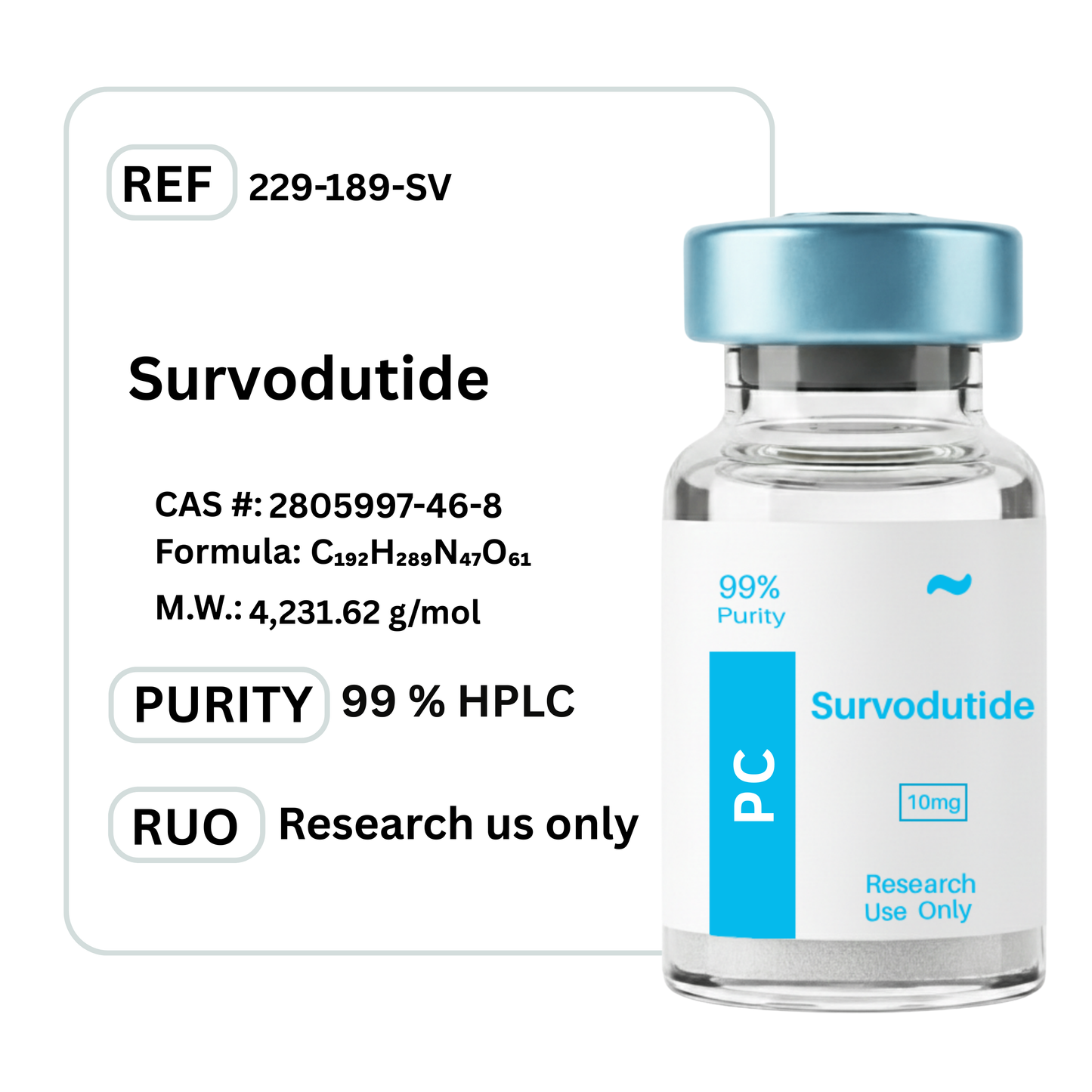
Survodutide Overview
Survodutide is a specialized synthetic research peptide defined by its powerful and balanced dual-agonist pharmacology. It is engineered to achieve concurrent activation of the glucagon-like peptide-1 receptor (GLP-1R) and the glucagon receptor (GCGR). This targeted molecular design facilitates the study of a coordinated metabolic response, utilizing both incretin and glucagon signaling pathways to comprehensively regulate body weight, appetite, glucose homeostasis, and energy expenditure. This dual mechanism provides a robust platform for investigating integrated metabolic improvement.
Survodutide 10mg: Research Utility and Critical Endpoints
The 10mg compound is intended for use by qualified scientific investigators exploring its utility in significant metabolic pathologies, specifically obesity, type 2 diabetes mellitus (T2DM), and metabolic dysfunction-associated steatotic liver disease (MASLD). Researchers evaluate Survodutide’s impact across critical metabolic measures:
- Targeted Visceral Adiposity Loss: Quantifying the reduction of deep, metabolically harmful fat.
- Favorable Lipid Profile Shifts: Monitoring the normalization of circulating lipids and lipoproteins.
- Durable Glycemic Stability: Assessing the long-term stabilization of blood glucose metrics.
The dual action offers a synergistic metabolic advantage: GLP-1R activity drives potent effects on satiety and insulin secretion, while GCGR activity increases the body's energy consumption and mobilizes fat stores via fatty acid oxidation.
Survodutide Structure
Survodutide is a meticulously synthesized, linear polypeptide. Its molecular structure is engineered for high specificity, ensuring effective, concurrent activation of both the GLP-1R and GCGR. The high purity and structural identity required for reliable research are analytically confirmed using rigorous methods, including Mass Spectrometry and High-Performance Liquid Chromatography.
Structural Solution Formula: The chemical formula for the research compound Survodutide is C227H351N61O71S. The calculated molar mass is approximately 5110.6 grams per mole.
Survodutide Research
Survodutide is a leading focus in translational research due to its promising effects across multiple, intertwined metabolic disorders.
Mechanistic Summary of Research Benefits
Research Domain
Receptor Mechanism
Key Physiological Effect
Primary Research Finding
Weight Reduction
Dual action on satiety (GLP-1R) and energy expenditure (GCGR).
Sustained reduction in caloric intake and increased catabolism.
Significant, dose-dependent loss of total body weight and visceral fat.
Liver Health
GCGR-mediated hepatic lipid clearance.
Enhanced fatty acid oxidation and reduced lipid synthesis in the liver.
Marked decrease in hepatic steatosis (liver fat) and improved liver biomarkers.
Glycemic Control
GLP-1R-mediated insulinotropic and insulin sensitizing effects.
Improved beta-cell function and superior glucose regulation.
Stability in fasting and postprandial blood glucose and lowered HBA1c.
Energy Expenditure
GCGR activation.
Increase in resting metabolic rate and substrate utilization.
Enhancement of energy expenditure and whole-body fat oxidation.
Survodutide and Weight Reduction
Translational studies have demonstrated significant, dose-dependent reductions in body mass, specifically targeting metabolically harmful visceral adiposity. This powerful effect stems from the coordinated dual action: enhanced satiety (GLP-1R) leading to reduced caloric intake, and increased basal metabolic rate (GCGR) promoting higher energy expenditure. Research aims to confirm the durability and long-term safety profile of this weight reduction.
Survodutide and Liver Fat Content
A defining research observation is the compound’s potent ability to reduce hepatic steatosis and improve crucial liver function biomarkers. These outcomes are highly relevant to the study of MASLD and MASH. Survodutide is hypothesized to exert its effect by accelerating hepatic lipid turnover and promoting fat oxidation pathways, supporting its role in improving hepatic metabolic health.
Survodutide and Glycemic Control
The compound’s potent activation of the GLP-1 receptor is linked to enhanced insulin sensitivity and improved regulation of both fasting and meal-related glucose excursions. This dual-agonist approach, integrating GCGR-driven metabolic benefits, provides a robust model for studying superior glycemic stability and flexibility compared to therapies targeting GLP-1 alone.
Survodutide and Cardiometabolic Health
The research scope extends to Survodutide’s systemic effects on cardiovascular risk. Protocols monitor improvements in lipid profiles (dyslipidemia), reductions in inflammatory markers, and positive modulation of blood pressure. The integrated metabolic action aims to reduce global cardiovascular risk by addressing multiple co-morbidities simultaneously.
Survodutide and Energy Expenditure
GCGR engagement is a unique and key element of the mechanism, primarily driving an increase in the metabolic rate and facilitating the mobilization of stored fatty acids. This action encourages the body to rely more heavily on fat stores for energy. Experimental data supports increases in resting energy expenditure and enhanced metabolic flexibility.
Research Disclaimer: The Survodutide research compound is intended exclusively for in-vitro laboratory research use by qualified professionals. It is not approved for human or veterinary administration or for use outside of a controlled research setting.
Article Author and Scientific Data Acknowledgement
Article Author
This product literature summary was prepared by Dr. Philip N. Newsome, M.D., Ph.D. Dr. Newsome is a leading international expert in hepatology and metabolic research, renowned for his contributions to the study of obesity, type 2 diabetes, and liver disease. He serves as the Director of the Centre for Liver and Gastrointestinal Research at the University of Birmingham, United Kingdom. Dr. Newsome has been a principal investigator in clinical trials examining dual GLP-1/glucagon receptor agonists, including Survodutide, for use in Metabolic Dysfunction-Associated Steatotic Liver Disease (MASLD).
Scientific Journal Author Acknowledgment
The summary of scientific data is based on the published research of Dr. Philip N. Newsome, Dr. Rachel L. Batterham, Dr. Brian Finan, Dr. Rui Godinho, and Dr. Thomas A. Wadden, and their respective collaborators. Their collective work has provided critical insights into the role of dual GLP-1/glucagon receptor modulation in regulating body weight, glucose balance, hepatic lipid metabolism, and overall cardiometabolic health. Their authoritative findings have been featured in premier journals, including The Lancet, Nature Medicine, Cell, Diabetes, Obesity and Metabolism, and Obesity (Silver Spring) between 2015 and 2024.
This acknowledgment is provided solely to recognize the academic contributions of these noted researchers and their teams. It is not to be construed as an endorsement or promotional statement for this product. Matreal Peptides Canada confirms no formal affiliation, sponsorship, or professional relationship with these individuals or their institutions.
Reference Citations
STORAGE
Storage Instructions
Survodutide is provided in a stable form achieved through lyophilization (freeze-drying). This manufacturing method protects the peptide's integrity and stability during transit, typically for a period of 3 to 4 months.
- Lyophilized State: Lyophilization involves freezing the peptide and removing water content via sublimation under vacuum. The resulting white, crystalline powder is highly stable. It is suitable for short-term storage at room temperature (for a few weeks) or for medium-term storage in a refrigerator (below 4 degrees C or 39 degrees F).
- Aqueous Solution: Once reconstituted with bacteriostatic water, the peptide solution becomes less stable. The solution must be stored under refrigerated conditions (below 4 degrees C or 39 degrees F) to maintain effectiveness, with a stability limit typically set at 30 days.
Best Practices For Storing Peptides
Strict adherence to storage guidelines is essential for accurate and reliable laboratory research, preventing degradation from various environmental factors.
Storage State
Recommended Temperature
Stability Duration
Preservation Note
Short-Term (Lyophilized)
Refrigeration: below 4 degrees C (39 degrees F)
Several weeks to months
Shield from light; minimize air exposure upon opening.
Long-Term (Lyophilized)
Deep Freezer: -80 degrees C (-112 degrees F)
Several months to years
Optimal stability; aliquot to prevent freeze-thaw degradation.
In Solution (Reconstituted)
Refrigeration: below 4 degrees C (39 degrees F)
Up to 30 days
Use sterile, slightly acidic buffers (pH 5-6); highly susceptible to degradation.
Preventing Oxidation and Moisture Contamination
The chemical integrity of peptides is sensitive to moisture and atmospheric oxygen.
- Moisture Control: To prevent condensation (which leads to hydrolysis) on the cold lyophilized powder, researchers must allow the sealed vial to fully reach room temperature before opening it.
- Oxidation Control: Limit air exposure. Promptly reseal the container after dispensing the required amount. For peptides sensitive to oxidation (those containing Cys, Met, or Trp residues), consider storing the unused material under a dry, inert gas such as nitrogen or argon.
Minimizing Freeze-Thaw Cycles
Repeated temperature cycling drastically accelerates degradation. To ensure maximal stability for long-term research:
- Aliquot the entire lyophilized stock into smaller, experimental-sized portions immediately upon product receipt.
- Store these aliquots securely in the deep freezer.
- Avoid using standard frost-free freezers, which introduce temperature variations during their defrost cycles that compromise peptide integrity.