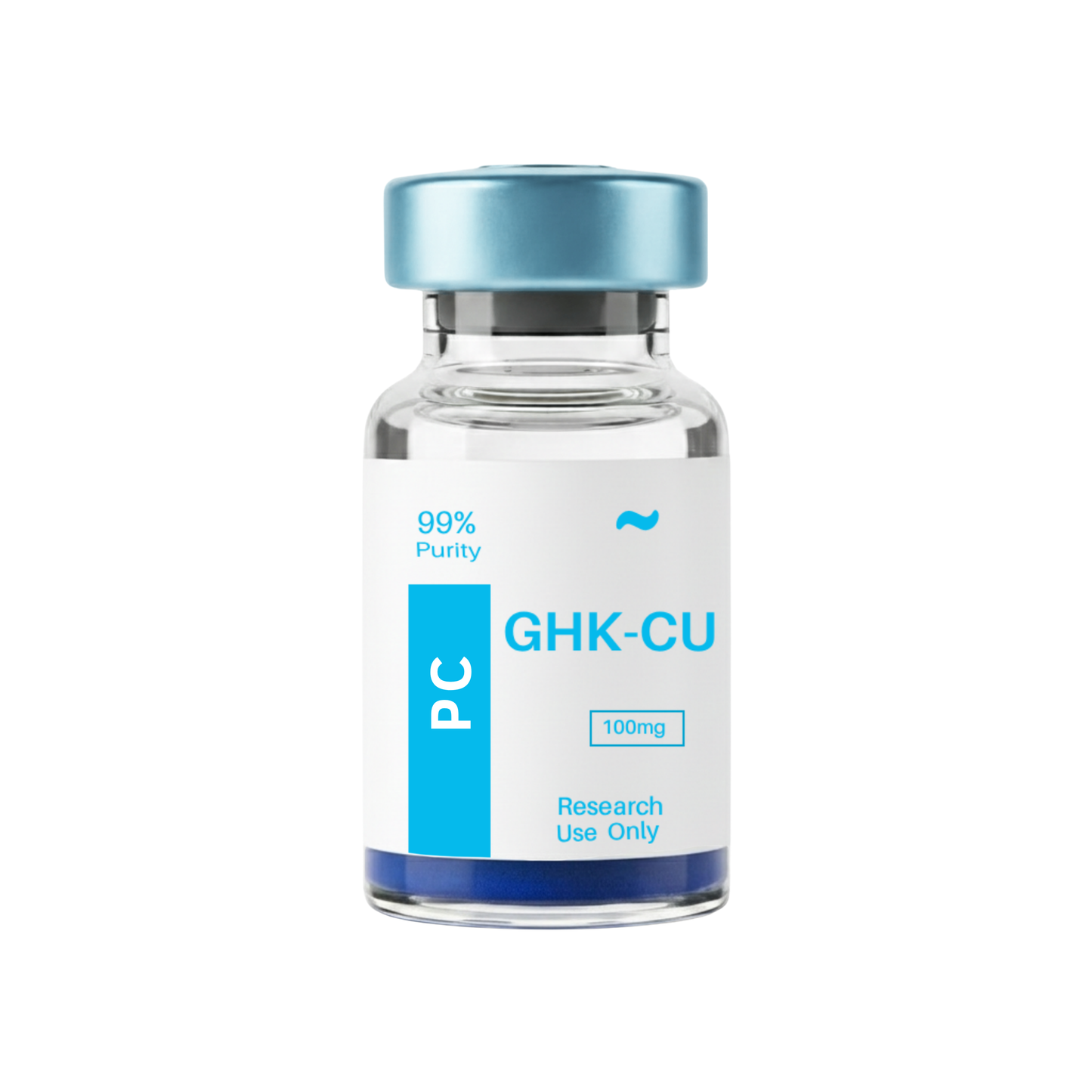
GHK-Cu
GHK-Cu is a naturally occurring tripeptide–copper complex (Gly–His–Lys bound to Cu²⁺) originally isolated from human plasma and later identified in urine and saliva. Research shows that GHK-Cu supports wound healing, modulates immune defenses, exhibits anti-aging and antioxidant effects, promotes protein synthesis, shows antimicrobial activity, and improves the condition of skin and dermal fibroblasts.
GHK-Cu Research
1. GHK-Cu and Skin Healing
As a natural component of human blood, GHK-Cu is closely involved in cutaneous regeneration processes. In skin culture experiments, GHK has been found to:
- Increase collagen synthesis while also supporting controlled collagen breakdown
- Regulate glycosaminoglycan metabolism
- Influence multiple extracellular matrix components, including proteoglycans and chondroitin sulfate
These effects are partly explained by GHK-Cu’s ability to recruit and activate:
- Fibroblasts
- Immune cells
- Endothelial cells
Collectively, these cell types are directed to injury sites, where GHK-Cu appears to coordinate their roles in wound closure and matrix remodeling.
Reported clinical and preclinical outcomes include:
- Improved skin elasticity and resilience
- Tighter, firmer skin
- Reduced signs of photodamage (sun damage)
- Decreased hyperpigmentation
- Reduced prominence of fine lines and wrinkles
By regulating collagen dynamics, GHK-Cu contributes to:
- Decreased scar prominence
- Reduced risk of hypertrophic scarring
- Smoother, more even skin texture
- Structural repair of aged or photodamaged skin
These actions are linked in part to enhanced transforming growth factor-β (TGF-β) activity. GHK-Cu is believed to act through several interconnected biochemical and gene regulatory pathways.
In murine burn studies, GHK-Cu has accelerated healing by up to 33%. In addition to mobilizing reparative cells, it promotes angiogenesis, which is critical in burned tissue where normal vascularization has been disrupted.
2. GHK-Cu and Bacteria
Uncontrolled bacterial and fungal colonization is a common cause of delayed or non-healing wounds, especially in burns and in patients with chronic diseases such as diabetes or immunodeficiency.
GHK-Cu, when formulated with specific fatty acids, forms a potent antimicrobial complex that displays activity against multiple bacteria and fungi commonly found in chronic skin and soft tissue infections.
In clinical trials with diabetic patients, topical GHK-Cu treatment of diabetic ulcers has been shown to surpass standard treatment protocols, yielding:
- Approximately 40% higher wound closure rates
- Around 27% lower infection rates
These outcomes coincided with the development of healthier granulation tissue and better-quality wound beds in ischemic open ulcers.
3. GHK-Cu, Cognition, and Nervous System Function
Neurodegenerative disease, including Alzheimer’s, is characterized by progressive neuronal death. While mechanisms remain incompletely defined, GHK-Cu has been investigated for its potential to counter declines in neural function.
Studies report that GHK-Cu can:
- Promote angiogenesis in nervous system tissue
- Increase nerve growth factor (NGF) levels
- Reduce anxiety-like behaviors in rodent models
- Partially normalize gene expression patterns related to neuronal health and cognitive function
GHK-Cu is relatively abundant in the brain at younger ages but declines over time. Evidence indicates that physiological levels help buffer tissues against insults such as gene dysregulation, and that age-related reductions in GHK-Cu may contribute to neurodegenerative onset and progression.
In rat models of intracerebral hemorrhage and stroke, GHK-Cu appears to exert neuroprotective effects by inhibiting apoptosis through the miR-339-5p/VEGFA pathway. Treatment significantly decreased neuron loss that is otherwise driven by elevated miR-339-5p expression.
4. GHK-Cu and Side Effects of Chemotherapy
Bleomycin and similar chemotherapeutic agents can induce lung fibrosis, a serious and often limiting adverse effect. In mice, GHK-Cu has been shown to:
- Attenuate bleomycin-induced pulmonary fibrosis
- Reduce pro-inflammatory signaling in lung tissue
Mechanistic data suggest that GHK-Cu acts in part by modulating:
These cytokines are central drivers of inflammatory and fibrotic processes within the lung extracellular matrix and epithelium. By dampening their activity, GHK-Cu reduces fibrotic remodeling and helps maintain pulmonary function.
Similar protective effects were documented in mouse models of acute respiratory distress syndrome (ARDS), where GHK-Cu improved outcomes, again primarily by reducing inflammatory injury.
5. GHK-Cu and Pain Reduction
Preclinical rodent research has shown that GHK-Cu produces a dose-related decrease in pain-induced aggressive–defensive behavior, consistent with peripheral analgesic action. Additional work suggests that certain GHK-related oligopeptides influence L-arginine’s analgesic and antiepileptogenic effects, potentially enhancing its pain-modulating profile.
These findings point to GHK-Cu as a potential lead compound or model for developing non-opioid analgesics that circumvent the side effects commonly associated with current pain medications.
In animal studies, GHK-Cu has demonstrated minimal side effects, low oral bioavailability, and high subcutaneous bioavailability. However, animal dosing cannot be translated directly to humans. GHK-Cu provided by Peptide Sciences is strictly for educational and scientific research use and is not intended for human consumption or clinical application. It should only be acquired and utilized by appropriately trained medical and research professionals.
Article Author
This review was researched, edited, and organized by Dr. Logan, M.D. Dr. Logan earned a medical degree from Case Western Reserve University School of Medicine and holds a B.S. in molecular biology.
Scientific Journal Author
Loren Pickart, Ph.D. is recognized as a primary contributor to the scientific understanding of GHK and GHK-Cu. He has authored 109 publications and has been involved in:
- Patent development related to GHK
- Large-scale analyses of GHK’s influence on human gene expression (over 4,150 genes)
His research has investigated GHK’s potential roles in:
- Skin inflammation
- Metastatic cancer
- Chronic obstructive pulmonary disease (COPD)
and has revealed broader beneficial effects on:
- Nervous system function
- Gastrointestinal system
- Mitochondrial activity
Dr. Pickart’s autobiographical notes describe his scientific background, motivations, and long-standing focus on peptide biology.
He is referenced here solely to acknowledge and credit his scientific work. This mention does not indicate endorsement of this product, nor any financial, professional, or other relationship between Peptide Sciences and Dr. Pickart.
Referenced Citations
- Pickart L, Vasquez-Soltero JM, Margulies A. GHK Peptide as a Natural Modulator of Multiple Cellular Pathways in Skin Regeneration. BioMed Res Int. 2015;2015:648108.
- Gruchlik A, Chodurek E, Dzierzewicz Z. Effect of GLY-HIS-LYS and its copper complex on TGF-β secretion in normal human dermal fibroblasts. Acta Pol Pharm. 2014;71(6):954–958.
- Pickart L, Margulies A. Regenerative and Protective Actions of the GHK-Cu Peptide in the Light of the New Gene Data. Int J Mol Sci. 2018;19(7).
- Wang X, et al. GHK-Cu liposomes accelerate scald wound healing in mice by promoting cell proliferation and angiogenesis. Wound Repair Regen. 2017;25(2):270–278.
- Kulawska M, Kulawska-Kaczur J, Dzerdzinska K. In vitro studies of antimicrobial activity of Gly-His-Lys conjugates as potential and promising candidates for therapeutics in skin and tissue infections. Bioorg Med Chem Lett. 2015;25(3):542–546.
- Mulder GD, et al. Enhanced healing of ulcers in patients with diabetes by topical treatment with glycyl-L-histidyl-L-lysine copper. Wound Repair Regen. 1994;2(4):259–269.
- Canapp SO, et al. The effect of topical tripeptide-copper complex on healing of ischemic open wounds. Vet Surg. 2003;32(6):515–523.
- Pickart L, Vasquez-Soltero JM, Margulies A. The Effect of the Human Peptide GHK on Gene Expression Relevant to Nervous System Function and Cognitive Decline. Brain Sci. 2017;7(2).
- Zhang H, Wang Y, He Z. Glycine-Histidine-Lysine (GHK) Alleviates Neuronal Apoptosis Due to Intracerebral Hemorrhage via the miR-339-5p/VEGFA Pathway. Neuropsychiatr Dis Treat. 2018;14:643–655.
- Zhou XM, et al. GHK Peptide Inhibits Bleomycin-Induced Pulmonary Fibrosis in Mice by Suppressing TGFβ1/Smad-Mediated Epithelial-to-Mesenchymal Transition. Front Pharmacol. 2017;8:904.
- Park J-R, Lee H, Kim S-I, Yang S-R. The tri-peptide GHK-Cu complex ameliorates lipopolysaccharide-induced acute lung injury in mice. Oncotarget. 2016;7(35):58405–58417.
- Senel-Yanova LA, Deligheyan ME. Effects of Tripeptide Gly-His-Lys in Pain-Induced Aggressive-Defensive Behavior in Rats. Bull Exp Biol Med. 2017;164(2):140–143.
- Senel-Yanova LA, Proshlyakov DV. Binding of Oligopeptides to L-Arginine Inverts Its Analgesic and Antiepileptogenic Effects. Bull Exp Biol Med. 2018;165(5):621–624.