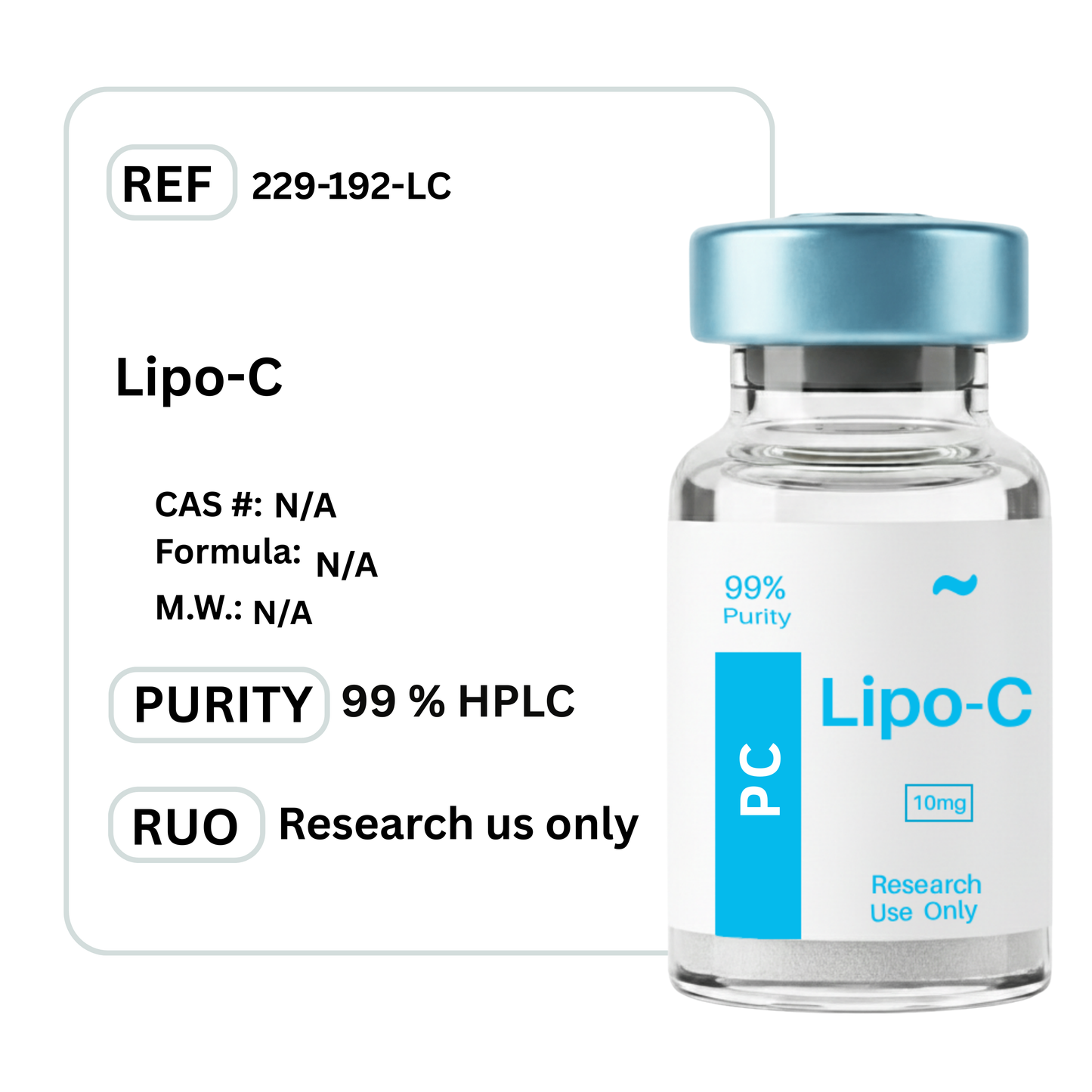
Lipo-C Overview
Lipo-C is a specialized research formulation consisting of L-carnitine conjugated to a lipophilic moiety. It is a compound developed for the investigation of cellular fatty acid transport, the process of mitochondrial beta-oxidation, and the regulation of metabolic energy in controlled laboratory settings.
In research models, Lipo-C is studied for its capacity to:
- Enhance mitochondrial uptake of fatty acids.
- Support increased lipid turnover.
- Modulate the cell's preference for metabolic substrates, particularly under conditions of energetic stress.
Research explores how this compound influences the transport of long-chain acyl-CoA into the mitochondria , the function of the mitochondrial respiratory chain, and its downstream effects on cellular lipid accumulation and energy balance.
Lipo-C is used in scientific settings to evaluate the metabolic-endocrine modulation of lipolysis, fatty acid oxidation, adipocyte metabolism, and mitochondrial biogenesis. Investigators also examine its potential impact on systemic lipid profiles, visceral fat mass, and shifts in energy expenditure during experimental dietary challenge or insulin-resistance models.
Lipo-C Structure
Lipo-C is derived from L-carnitine that has been esterified with a lipophilic moiety. This structural modification is specifically designed to optimize the compound's cellular uptake and targeted delivery to the mitochondria in experimental systems. A definitive single molecular formula is not provided as minor structural variations may occur between synthesis batches.
Rigorous analytical testing is performed to confirm the identity and high purity of the material for this specific batch.
Analytical Parameter
Result
Observed Mass (MS)
711.9 Da
Purity (HPLC)
99.42%
Batch Number
2025007
Primary Retention Time
3.48 min
Instrument Used
LCMS-7800 Series (Calibrated)
Analytical Note: The identity of the primary peak was confirmed via mass spectrometry and retention time. The observed trace secondary peak area is 0.58%.
Lipo-C Research
Lipo-C and its Role in Fatty Acid Metabolism
Experimental research explores the capacity of Lipo-C, an L-carnitine–based derivative, to facilitate the mitochondrial transport of long-chain fatty acids, a rate-limiting step for their oxidative utilization. Studies suggest that by promoting efficient fatty acid entry into mitochondria, Lipo-C may enhance overall cellular energy production and metabolic efficiency under controlled, substrate-enriched experimental conditions.
Lipo-C and Cellular Energy Regulation
Further investigations focus on Lipo-C’s potential to stimulate lipolytic activity within adipocytes, leading to increased free fatty acid turnover and reduced intracellular triglyceride accumulation. Research also examines its influence on mitochondrial biogenesis through the potential activation of regulatory pathways such as PGC-1alpha, which governs oxidative enzyme expression and energy metabolism.
Collectively, these findings provide a foundation for studying Lipo-C’s potential in metabolic research—particularly its impact on visceral fat reduction, hepatic lipid balance, and insulin sensitivity—though its use remains strictly limited to controlled laboratory research by qualified professionals.
The Lipo-C research compound is designated solely for controlled experimental and investigative purposes within certified laboratory environments. It must be handled and utilized only by trained and qualified research professionals. This material is strictly prohibited for human or veterinary use, including any form of therapeutic, diagnostic, or clinical administration.
Article Author: Dr. Charles Hoppel, Ph.D.
Dr. Hoppel is a highly respected biochemist best known for his pivotal contributions to the study of mitochondrial energy metabolism and the biochemical functions of L-carnitine in fatty acid oxidation. His career research has greatly deepened scientific knowledge of mitochondrial transport processes, metabolic regulation, and the mechanisms governing carnitine-dependent beta-oxidation under both physiological and pathological conditions.
Scientific Journal Author
Dr. Charles Hoppel has carried out extensive investigations into the metabolism of carnitine and its impact on mitochondrial bioenergetics, focusing on its role in fatty acid transport, oxidative enzyme systems, and energy balance within cells. His work—alongside that of colleagues including W.C. Stanley, C.J. Rebouche, L.L. Jones, and R. Ringseis—has been instrumental in elucidating the biochemical and physiological pathways involving L-carnitine and related compounds. Collectively, their studies provide the scientific groundwork supporting present-day experimental research into Lipo-C and similar metabolic formulations.
Dr. Hoppel and his collaborators are acknowledged for their substantial contributions to advancing the understanding of carnitine metabolism and mitochondrial function. This recognition is intended solely to credit the scientific research of Dr. Hoppel and his colleagues. It does not imply any form of endorsement or association with this product. Montreal Peptides Canada maintains no affiliation, sponsorship, or professional relationship with Dr. Hoppel or any of the researchers referenced.
Reference Citations
- Stanley WC, et al. Regulation of mitochondrial fatty acid oxidation by L-carnitine. J Mol Cell Cardiol. 1999;31(10):1435-1448. PMID: 10502507.
- Rebouche CJ. Carnitine function and requirements during the life cycle. Fetal Pediatr Pathol. 2004;23(1-2):99-114. PMID: 15362046.
- Jones LL, et al. Role of L-carnitine in cardiovascular disease. Cardiovasc Res. 1999;42(2):219-223. PMID: 10364221.
- Hoppel C. The role of carnitine in normal and altered fatty acid metabolism. Am J Kidney Dis. 2003;41(4 Suppl 4):S4-12. PMID: 12664513.
- Ringseis R, et al. Carnitine transport and mitochondrial metabolism. Biochim Biophys Acta. 2014;1842(9):1282–1293. PMID: 24950924.
- ClinicalTrials.gov Identifier: NCT01376341. L-carnitine derivative supplementation in metabolic syndrome research.
- ClinicalTrials.gov Identifier: NCT02410932. Mitochondrial fatty acid oxidation enhancement in human research settings.
Storage Instructions
All products are produced through a lyophilization (freeze-drying) process, which preserves stability during shipping for approximately 3–4 months.
Best Practices For Storing Peptides
Proper storage of peptides is crucial to maintaining the accuracy and reliability of laboratory results by preventing contamination, oxidation, and degradation.
Product State
Storage Duration
Recommended Temperature
Key Practice
Lyophilized (Dry Powder)
Short-Term (Days/Weeks/Months)
Refrigeration (below 4 degrees Celsius)
Must be kept cool and protected from light.
Lyophilized (Dry Powder)
Long-Term (Months/Years)
Freezer (at -80 degrees Celsius)
Avoid freeze-thaw cycles and frost-free freezers.
Reconstituted Solution
Short-Term (Up to 30 days)
Refrigeration (below 4 degrees Celsius)
Use sterile buffers (pH 5–6) or bacteriostatic water. Aliquot immediately.
Preventing Oxidation and Moisture Contamination
- Moisture: Always allow the peptide vial to reach room temperature before opening when removing from the freezer, as this prevents condensation from forming on the cold material.
- Air Exposure: Minimize air exposure to reduce oxidation. After removing the required amount, promptly reseal the container. Consider storing the remaining peptide under a dry, inert gas (nitrogen or argon). Peptides containing Cysteine (C), Methionine (M), or Tryptophan (W) are highly sensitive to air oxidation.
- Aliquoting: To preserve long-term stability, divide the total peptide quantity into smaller aliquots for individual experimental use. This method prevents repeated exposure to temperature and air fluctuations.
Storing Peptides In Solution
Peptide solutions have a significantly shorter shelf life and are more susceptible to degradation.
- Instability: Peptides containing Cys, Met, Trp, Asp, Gln, or N-terminal Glu residues tend to degrade more rapidly in solution.
- Recommendations: If storage in solution is necessary, use sterile buffers with a pH between 5 and 6. Divide the solution into aliquots to minimize freeze-thaw cycles. Most solutions remain stable under refrigeration for up to 30 days.
Peptide Storage Containers
Containers must be clean, durable, and chemically resistant.
- Material: High-quality glass vials offer the best combination of clarity, stability, and chemical inertness. Plastic vials (polystyrene or polypropylene) are also suitable.
- Sizing: Containers should be appropriately sized to match the quantity of peptide being stored, minimizing excess air space.
Peptide Storage Guidelines: General Tips
- Store peptides in a cold, dry, and dark environment.
- Avoid repeated freeze-thaw cycles.
- Minimize exposure to air and protect from light.
- Do not store peptides in solution long term; keep them lyophilized whenever possible.