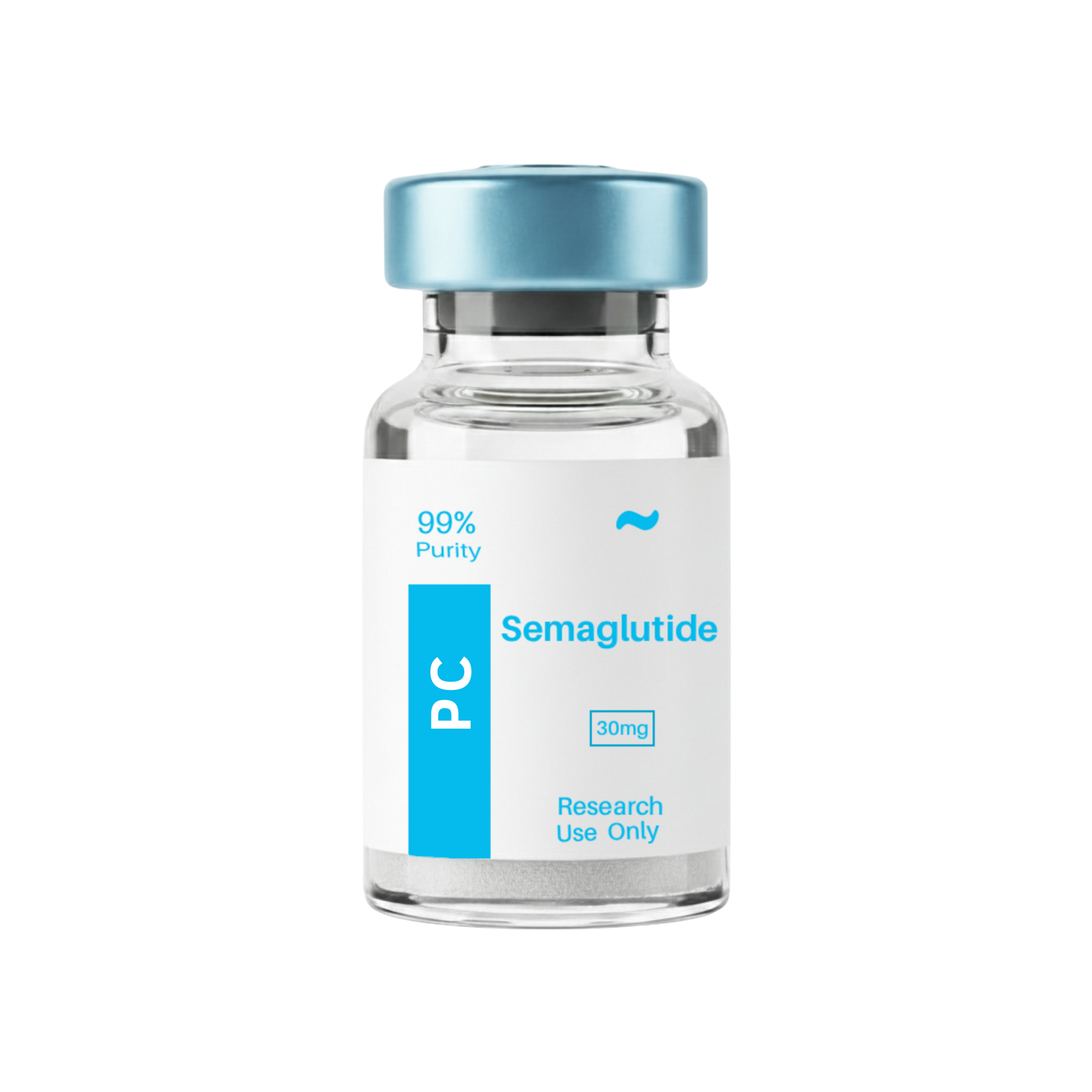
SEMAGLUTIDE PEPTIDE
Semaglutide is a highly sophisticated, synthetic analogue of the glucagon-like peptide-1 (GLP-1) hormone. Its structure incorporates specific chemical modifications to dramatically enhance its resistance to metabolic inactivation and enable high-affinity, reversible binding to serum albumin. This design ensures a profoundly extended circulatory half-life. As a long-acting GLP-1 receptor agonist, Semaglutide is a pivotal compound for research addressing glucose regulation, the neuroendocrine basis of satiety and weight loss, and comprehensive cardiometabolic intervention strategies.
SEMAGLUTIDE PEPTIDE OVERVIEW
The mechanism of Semaglutide involves the persistent activation of the GLP-1 receptor. As an effective long-acting GLP-1 receptor agonist (GLP-1RA), its core metabolic activity centers on modulating pancreatic hormone secretion: it strongly stimulates the release of insulin from beta-cells while simultaneously inhibiting the release of glucagon from alpha-cells, both actions being critically glucose-dependent.
Beyond the pancreas, Semaglutide influences gastrointestinal function by slowing gastric emptying and acts on central regulatory centers in the hypothalamus to reduce appetite and increase satiety signals. This multi-systemic action profile makes it a compelling research tool for studying integrated metabolic control and energy balance, with effects consistently demonstrated in preclinical and clinical research models.
The achieved stability and duration of action are directly engineered into the peptide structure:
- Resistance to Enzymatic Degradation: Stability against the widely distributed Dipeptidyl Peptidase-4 (DPP-4) enzyme is secured by substituting the amino acid at position 8 with alpha-aminoisobutyric acid, shielding the peptide bond from cleavage.
- Prolonged Systemic Exposure: A C18 fatty diacid side chain attached to the Lysine residue at position 26 mediates strong, non-covalent binding to albumin, which acts as a protective carrier in the bloodstream.
These features extend the peptide's plasma half-life to approximately one week, ensuring sustained receptor occupancy and stable biological outcomes over long-term research protocols.
SEMAGLUTIDE PEPTIDE STRUCTURE
Attribute
Detail
Sequence
HXEGTFTSDVSSYLEGQAAK-OH.steric diacid-EFIAWLVRGRG
Molecular Formula
C187H291N45O59
Molecular Weight
4113.58 g/mol
PubChem CID
56843331
CAS Number
910463-68-2
Synonyms
Semaglutide, NN9535, OG217SC, NNC 0113-0217, GLP-1 receptor agonist (GLP-1RA), long-acting GLP-1 analog
Structural Solution Formula (Simplified)
Semaglutide's chemical formula is based on the GLP-1 sequence. It features N-terminal protection with L-Histidine. Its resistance to DPP-4 is achieved by the incorporation of alpha-aminoisobutyric acid at position 8. The extended half-life is due to a C18 octadecanedioic acid side chain (steric diacid) attached via a gamma-L-glutamic acid spacer to the epsilon-amino group of Lysine 26, enabling its binding to albumin.
SEMAGLUTIDE PEPTIDE RESEARCH
Glucose Metabolism
Semaglutide is a premier research compound for investigating the reversal of impaired glucose homeostasis. Its unique dual action—enhancing insulin secretion and suppressing glucagon release—is strictly glucose-dependent, offering a mechanism to lower blood sugar without increasing the risk of hypoglycemia. Research studies consistently report improvements in overall glycemic control, enhanced insulin sensitivity, and support for the functional integrity of pancreatic beta-cells in models of metabolic dysfunction.
Appetite and Weight Regulation
The study of Semaglutide is fundamental to understanding the physiology of energy balance and weight reduction. The peptide activates GLP-1 receptors in the hypothalamus, effectively targeting neural circuits responsible for hunger, satiety, and reward processing. This central mechanism results in reduced caloric intake and a shift in feeding behavior. Experimental models demonstrate consistent, sustained reductions in body weight and adiposity, establishing Semaglutide as a primary agent for obesity research.
Cardiometabolic Function
Research shows that Semaglutide provides benefits that extend to modulating cardiovascular risk factors. Studies indicate favorable effects such as lowering both systolic and diastolic blood pressure. It also modulates lipid metabolism, typically observed as reductions in triglycerides and LDL cholesterol, alongside the potential for increased HDL cholesterol. Furthermore, its potential to reduce systemic inflammation and oxidative stress underscores its importance in comprehensive cardiometabolic disease research.
Liver and Metabolic Health
In research focused on Nonalcoholic Fatty Liver Disease (NAFLD) and Nonalcoholic Steatohepatitis (NASH), Semaglutide has demonstrated the ability to reduce the accumulation of fat (steatosis) within liver tissue and improve circulating liver enzyme markers. These hepatoprotective effects are strongly linked to the peptide's capacity to improve systemic insulin sensitivity and reduce chronic liver inflammation, making it an indispensable tool for studying metabolic interventions in liver disease.
Pharmacokinetics
The highly optimized pharmacokinetic profile is central to Semaglutide's utility in chronic studies. The strategic albumin-binding modification provides a prolonged plasma half-life of approximately seven days. This extended circulation ensures sustained and stable activation of the GLP-1 receptor, greatly enhancing the feasibility and consistency of outcomes in long-term research models targeting metabolic, cardiovascular, and hepatic conditions.
Note: Semaglutide peptide is intended strictly for research and laboratory use only and is not approved for human consumption.
ARTICLE AUTHOR
The information presented above was compiled, reviewed, and organized by Dr. Jens Lau, PhD.
Dr. Lau is an acclaimed peptide chemist, notably recognized for his essential role in the discovery, chemical optimization, and development of Semaglutide, a pioneering long-acting GLP-1 receptor agonist. His doctoral expertise in chemistry underpins his significant contributions to advanced peptide drug design, focusing specifically on enhancing the structural stability and metabolic longevity of GLP-1 analogs.
SCIENTIFIC JOURNAL AUTHOR
Dr. Daniel J. Drucker is a globally renowned endocrinologist and scholar, distinguished by an expansive bibliography of over 500 peer-reviewed articles and massive scientific citations. His foundational research centers on incretin hormone biology, GLP-1 receptor signaling pathways, and advancing the clinical application of GLP-1 based compounds for conditions like diabetes and obesity.
Dr. Drucker is acknowledged as a leading global authority whose research underpins the scientific understanding of GLP-1 receptor agonists, including Semaglutide. He is cited exclusively for his documented scientific research contributions and is not an endorser or promoter of this product. There is no affiliation or professional relationship, expressed or implied, between this supplier and Dr. Drucker. The referencing of his research solely acknowledges his critical scientific role in establishing the mechanistic understanding and therapeutic potential of GLP-1 receptor science. Dr. Daniel J. Drucker is referenced in [2] within the citation list.
REFERENCE CITATIONS
[1] Lau J, et al. Discovery of Semaglutide, a long-acting GLP-1 analog. J Med Chem. 2015;58(18):7370-7380. https://pubmed.ncbi.nlm.nih.gov/26307822/
[2] Drucker DJ. Mechanisms of action and therapeutic application of GLP-1 receptor agonists. Cell Metab. 2018;27(4):740-756. https://pubmed.ncbi.nlm.nih.gov/29551581/
[3] Jensen L, et al. Semaglutide pharmacokinetics and metabolic effects. Diabetes Obes Metab. 2017;19(1):34-43. https://pubmed.ncbi.nlm.nih.gov/27699838/
[4] Wilding JPH, et al. Semaglutide and weight management in clinical research. N Engl J Med. 2021;384(11):989-1002. https://pubmed.ncbi.nlm.nih.gov/33567185/
[5] Davies MJ, et al. Semaglutide's impact on glucose control and body weight. Lancet Diabetes Endocrinol. 2017;5(5):341-354. https://pubmed.ncbi.nlm.nih.gov/28237263/
[6] Nauck MA, et al. GLP-1 receptor agonists in metabolic disease models. Diabetologia. 2016;59(4):763-776. https://pubmed.ncbi.nlm.nih.gov/26802080/
[7] Holst JJ, et al. Physiology of GLP-1 and receptor pathways. Physiol Rev. 2017;97(2):1409-1439. https://pubmed.ncbi.nlm.nih.gov/28356471/
[8] Newsome PN, et al. Semaglutide in nonalcoholic steatohepatitis research. N Engl J Med. 2021;384(12):1113-1124. https://pubmed.ncbi.nlm.nih.gov/33761207/
[9] Nauck MA, Meier JJ. Pharmacology of GLP-1 receptor agonists. Diabetologia. 2019;62(10):1808-1823. https://pubmed.ncbi.nlm.nih.gov/31201557/
[10] Marso SP, et al. Cardiovascular outcomes with Semaglutide in metabolic studies. N Engl J Med. 2016;375(19):1834-1844. https://pubmed.ncbi.nlm.nih.gov/27633186/
STORAGE
Storage Instructions
The product is provided as a highly stable, white powder through the technique of lyophilization (freeze-drying). This advanced method removes water under vacuum, ensuring the peptide’s activity is preserved during shipment for a period of approximately 3 to 4 months.
- Lyophilized Peptide (Powder): For short-term experimental needs (several weeks or months), the powder is stable under refrigeration, below 4 degrees Celsius (39 degrees Fahrenheit), or even at controlled room temperature. For optimal, long-term stability required for research spanning years, the material must be archived in a freezer at -80 degrees Celsius (-112 degrees Fahrenheit).
- After Reconstitution (Solution): Following the addition of bacteriostatic water, the resulting liquid peptide must be stored under refrigeration, strictly maintained below 4 degrees Celsius (39 degrees Fahrenheit). In this dissolved form, the peptide is typically stable for up to 30 days.
Best Practices For Storing Peptides
Rigorous adherence to established storage procedures is mandatory for guaranteeing the accuracy and reproducibility of all experimental data. Proper handling is the primary defense against chemical degradation, oxidation, and contamination.
Storage Condition
Time Frame
Temperature
Notes
Lyophilized (Powder)
Short-term (Weeks/Months)
Below 4 degrees C (39 degrees F) or Ambient Temp
Must be shielded from light. Suitable for immediate research use.
Lyophilized (Powder)
Long-term (Years)
-80 degrees C (-112 degrees F)
Essential for maximizing peptide structural integrity and shelf-life.
Reconstituted (Solution)
Short-term (Up to 30 Days)
Below 4 degrees C (39 degrees F)
Requires preparation using sterile, bacteriostatic water.
General Storage Guidelines:
- Environmental Control: Store peptides in a consistently cold, dark, and dry environment.
- Temperature Stability: Avoid all repeated freeze-thaw cycles, as these fluctuations drastically accelerate degradation. Never use "frost-free" freezers, which introduce destabilizing temperature variations during their automatic defrost cycles.
- Aliquoting: To protect the bulk material from repeated environmental exposure, it is highly recommended to divide the total peptide into smaller, individual-use aliquots immediately upon receipt.
Preventing Oxidation and Moisture Contamination
Exposure to atmospheric moisture and oxygen are leading causes of peptide instability, particularly during retrieval from cold storage.
- Moisture Prevention: When removing frozen vials, it is critical to allow the container to fully reach room temperature before the seal is opened. This prevents ambient water vapor from condensing inside the cold vial and contaminating the peptide powder.
- Air Minimization: Minimize the time the container is open to the air. After dispensing the required amount, promptly reseal the vial. For oxygen-sensitive peptides (e.g., those containing Cysteine, Methionine, or Tryptophan), further protection can be achieved by storing the unused portion under a layer of inert gas (such as nitrogen or argon).
Storing Peptides In Solution
Peptides dissolved in solution are significantly more prone to chemical breakdown and bacterial growth than their lyophilized form.
- Vulnerable Residues: Peptides containing Cysteine, Methionine, Tryptophan, Aspartic acid, Glutamine, or N-terminal Glutamic acid residues are known to be chemically less stable in aqueous buffers.
- Buffer Conditions: If storing in solution is unavoidable, use sterile buffers maintained at a mildly acidic (typically between 5 and 6).
- Aliquot and Store: Solutions must be aliquoted to minimize freeze-thaw cycles. Less stable solutions should be stored frozen when not needed for immediate experiments.
Peptide Storage Containers
The choice of container impacts the long-term purity and concentration of the stored peptide.
- Material and Fit: Containers must be clean, chemically inert, durable, and appropriately sized to minimize air space above the material.
- Options: Both high-quality glass vials (offering excellent inertness) and plastic vials (polystyrene or polypropylene) are suitable. Plastic is often preferred for shipping due to its durability.
- Transfer: Transferring the peptide from a plastic shipping container to a high-quality glass vial may be considered for the best long-term archival storage conditions.