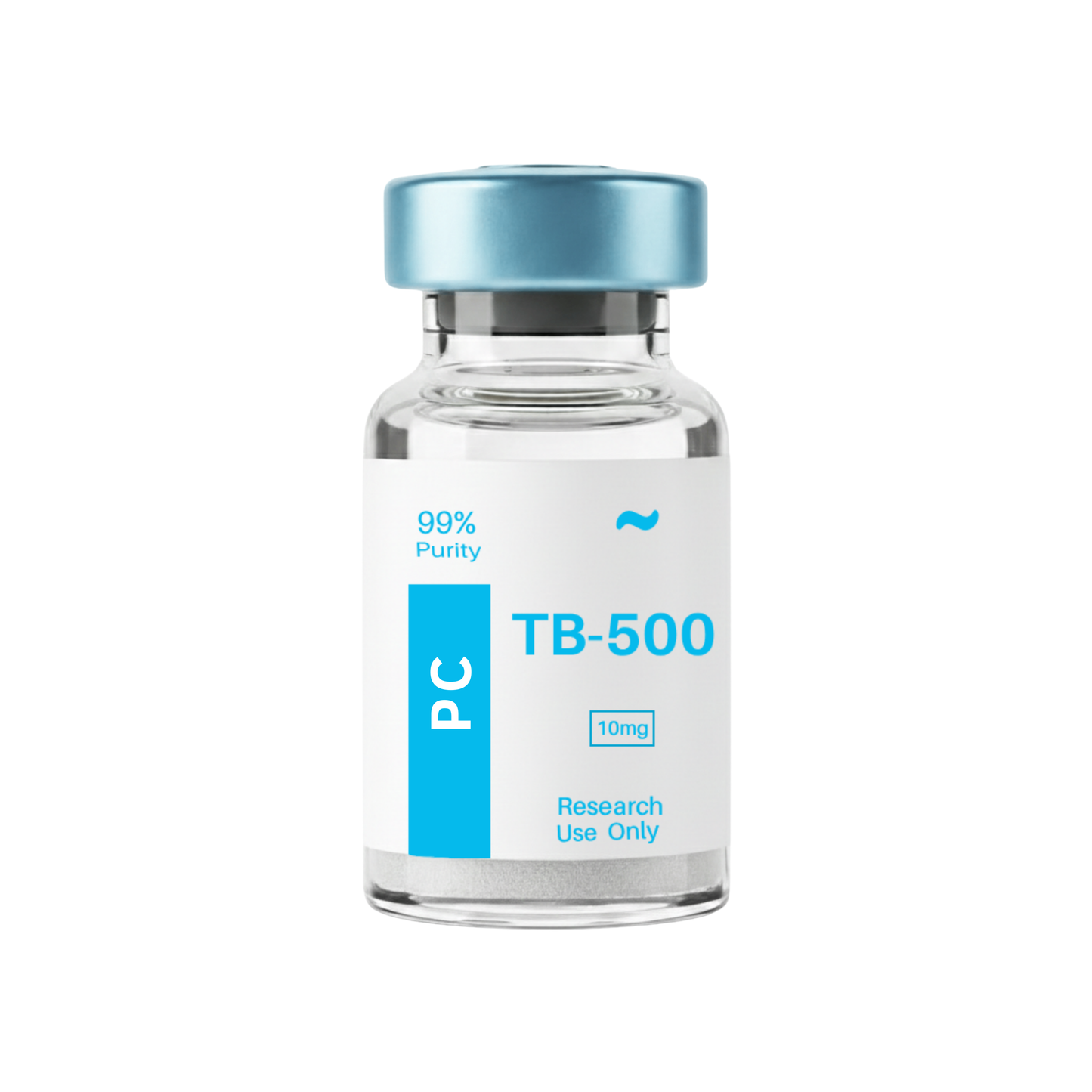
TB-500 Peptide
TB-500 is a meticulously synthesized peptide that mirrors the active domain of thymosin beta-4 (T beta 4), a protein universally present across human and animal cells. While the complete T beta 4 protein has 43 amino acids, TB-500 is a smaller, highly purified fragment. It is a cornerstone compound in regenerative research, extensively studied for its influence on cellular motility, angiogenesis, and the promotion of tissue regeneration. Research is directed at understanding its role in the accelerated and sustained recovery of structural tissues, including muscle, ligament, tendon, and the cardiovascular system.
TB-500 Peptide - 10mg Overview
The 10mg TB-500 product contains the seven-amino-acid sequence LKKETEQ, corresponding to residues 17–23 of the native thymosin beta-4. This is the recognized core functional segment responsible for high-affinity actin binding. In research, this segment is believed to precisely regulate actin polymerization, a key process that drives cell migration. By enhancing this dynamic, the peptide is theorized to facilitate the rapid, directed movement of repair cells to sites of injury, thereby optimizing the kinetics of tissue repair.
Investigative data suggests TB-500 influences inflammatory signaling pathways, potentially through the upregulation of microRNA-146a. This action supports its observed role in promoting endothelial cell formation, subsequent angiogenesis, and overall efficient wound healing. As an optimized synthetic analogue, TB-500 is utilized for its enhanced molecular stability and targeted bioactivity, which are advantageous features for rigorous and controlled laboratory experimentation.
TB-500 Peptide Mechanism of Action
TB-500's mechanism is defined by its ability to function as a potent actin-sequestering fragment of T beta 4. Actin is the structural protein that forms cellular microfilaments, which are crucial for maintaining cell shape, providing mechanical strength, enabling cell migration, and driving muscle function.
By effectively binding individual actin monomers, TB-500 shields these units from degradation and premature assembly, maintaining them in a readily available, protected pool. This sustained reserve of monomers ensures the capacity for rapid cytoskeletal remodeling (polymerization) on demand, providing the necessary molecular machinery for swift and directed cell movement—a fundamental requirement for initiating and completing tissue repair following injury.
Feature
Thymosin Beta-4 (T beta 4)
TB-500 Peptide
Purity
Biological variability
High, synthetic purity
Amino Acid Count
43 residues (full length)
7 residues (active core)
Stability in Solution
Lower
Enhanced molecular stability
Research Utility
Study of complex T beta 4 roles
Targeted actin-binding research
TB-500 (Thymosin Beta-4) Peptide Sequence
The exact, active amino acid sequence of the TB-500 heptapeptide is:
L-Lys-Lys-Glu-Thr-Glu-Gln-Lys
This sequence is an exact match to the critical actin-binding domain of thymosin beta-4, corresponding to residues 17 through 23.
TB-500 Structure Solution Formula (Example for 4mg/mL Concentration):
To prepare a 4mg per milliliter solution, reconstitute 10mg of lyophilized TB-500 powder with 2.5 milliliters of an appropriate sterile diluent, such as Bacteriostatic Water for Injection.
TB-500 Research
1. TB-500 and Neurologic Function
Studies have shown that TB-500 promotes the repair and remodeling of the central and peripheral nervous systems after injury. This effect is thought to involve the activation of oligodendrocytes and the enhancement of neovascularization and neuronal sprouting in damaged regions. These actions correlate with observed improvements in motor function, cognition, and behavior in animal models. Further research explores its potential to reduce oxidative stress and increase the survival of transplanted neural stem cells, relevant to spinal regeneration studies.
2. TB-500 and Blood Vessel Growth
TB-500 is a potent stimulator of VEGF, a molecule vital for forming new capillaries. Beyond this, research indicates TB-500 supports the full sequence of vascular development, including extracellular matrix reorganization and the differentiation of precursor cells into endothelial cells. Data shows that T beta 4 is essential for vascular stability, and its administration enhances capillary formation and pericyte recruitment at injury sites.
3. TB-500 and Hair Growth
The role of T beta 4 was discovered in mice lacking the gene, which showed significantly slowed hair regrowth. Conversely, models with T beta 4 overexpression demonstrated accelerated regrowth and higher hair follicle density, indicating a direct involvement in regulating the hair follicle cycling process.
4. TB-500 and Antibiotic Synergy
Addressing antibiotic resistance, studies showed that combining T beta 4 with the antibiotic ciprofloxacin significantly increased the antibiotic's therapeutic effect, accelerated healing, and reduced inflammation in models of bacterial infection. This establishes a research pathway for TB-500 analogues as potential synergistic agents.
5. TB-500 and Cardiovascular Health
Research over decades highlights T beta 4's benefits for the cardiovascular and renal systems. Key actions include promoting collateral blood vessel growth, enhancing endothelial cell migration, and improving cardiomyocyte survival post-myocardial infarction. The peptide is also studied for its role in modulating inflammation and limiting fibrosis.
6. TB-500 and Neurodegenerative Diseases
Research revealed that T beta 4 enhances autophagy, the critical cellular self-cleaning process that serves as the nervous system's main defense against neurodegeneration. By supporting this mechanism, T beta 4 offers a promising research tool for investigating therapeutic strategies against conditions like Alzheimer's and prion diseases.
7. TB-500 Has Wide Application
Given TB-500's fundamental involvement in actin regulation across various tissue types, its research potential is broad and continuously expanding. Its studied role in cardiovascular, neurological, and regenerative medicine confirms its status as an intensively investigated compound. TB-500 is strictly for research and laboratory purposes only and is not approved for human or animal use.
Article Author
This literature review was compiled, edited, and organized by Dr. Daniel C. Crockford, Ph.D. Dr. Crockford is a highly respected biomedical scientist known for his extensive research on thymosin beta-4 (T beta 4) and its synthetic counterpart, TB-500. His seminal work has been instrumental in advancing the scientific understanding of the peptide’s role in angiogenesis, tissue regeneration, and cellular repair. Dr. Crockford's published research, along with contributions from collaborators including N. Turjman, C. Allan, J. Angel, K.M. Malinda, I. Bock-Marquette, D. Philp, and A.L. Goldstein, has provided foundational knowledge regarding the function of T beta 4 analogues. This acknowledgment is solely for academic recognition and does not imply endorsement, affiliation, or sponsorship by the distributing company.
Reference Citations
- Malinda KM, et al. Thymosin beta 4 accelerates wound healing. J Invest Dermatol. 1999;113(3):364–368. https://www.sciencedirect.com/science/article/pii/S0022202X15405950
- Xu B, et al. Thymosin beta 4 enhances ligament healing in rats. Regul Pept. 2013;184:1-5. https://pubmed.ncbi.nlm.nih.gov/23523891/
- Bock-Marquette I, et al. Thymosin beta 4 activates integrin-linked kinase and promotes cardiac repair. Nature. 2004;432(7016):466-472. https://doi.org/10.1038/nature03000
- Srivastava D, et al. Cardiac repair with thymosin beta 4 and cardiac reprogramming factors. Ann NY Acad Sci. 2012;1270:66-72. https://pubmed.ncbi.nlm.nih.gov/23259435/
- Santra M, et al. Thymosin beta 4 regulation of microRNA-146a in inflammation. J Biol Chem. 2014;289(28):19508-19518. https://pubmed.ncbi.nlm.nih.gov/24860091/
- Philp D, et al. Thymosin beta 4 and tissue regeneration. J Invest Dermatol. 2004;123(4):802-809. https://pubmed.ncbi.nlm.nih.gov/15373782/
- Crockford D, et al. Thymosin beta-4: structure and function review. Ann NY Acad Sci. 2010;1194:179–189. https://pubmed.ncbi.nlm.nih.gov/20536459/
- Goldstein AL, et al. History and development of thymosins. Ann N Y Acad Sci. 2007;1112:1-13. https://pubmed.ncbi.nlm.nih.gov/17656565/
- Bock-Marquette I, et al. Thymosin beta 4 supports myocardial migration and survival. Nature. 2004;432:466-472. https://pubmed.ncbi.nlm.nih.gov/15565145/
- Crockford D, Turjman N, Allan C, Angel J. Thymosin beta 4: structure and function review. Ann N Y Acad Sci. 2010;1194:179-189. https://pubmed.ncbi.nlm.nih.gov/20536459/
REGULATORY DISCLAIMER: ALL ARTICLES AND PRODUCT INFORMATION PROVIDED ON THIS WEBSITE ARE FOR INFORMATIONAL AND EDUCATIONAL PURPOSES ONLY. The products offered are for in-vitro studies only (experiments performed outside the living body). These products are not medicines or drugs and have not been approved by the FDA to prevent, treat, or cure any medical condition. Bodily introduction of any kind into humans or animals is strictly forbidden by law.
STORAGE
Storage Instructions
TB-500 is stabilized using lyophilization (freeze-drying), a process that ensures stability for shipping over approximately 3–4 months at ambient temperatures. After reconstitution with bacteriostatic water, the solution requires refrigeration and remains stable for up to 30 days. The lyophilized powder is highly stable at room temperature for several weeks prior to reconstitution. For extended, long-term preservation (months to years), freezing at -80 degrees Celsius (-112 degrees Fahrenheit) is strongly recommended.
Best Practices For Storing Peptides
Proper storage is non-negotiable for preserving the purity and reliability of peptides for research.
Storage State
Recommended Temperature
Maximum Duration
Key Storage Practice
Lyophilized (Short-Term)
Below 4 degrees Celsius (39 degrees Fahrenheit), Refrigerated
Few days to several months
Keep protected from light
Lyophilized (Long-Term)
-80 degrees Celsius (-112 degrees Fahrenheit), Freezer
Several months to years
Minimize temperature fluctuations (freeze-thaw)
Reconstituted in Solution
4 degrees Celsius (39 degrees Fahrenheit), Refrigerated
Up to 30 days
Use sterile buffers (pH 5-6)
Environmental Control: Peptides should be stored in a cold, dry, dark place. Avoid repeated freeze-thaw cycles and the inherent temperature variations of frost-free freezers.- Moisture and Air: To prevent condensation, always allow the vial to reach room temperature before opening. Minimize air exposure by promptly resealing the container, ideally under an inert gas (nitrogen or argon).
- Aliquoting: For long-term preservation, divide the peptide into smaller, single-use aliquots to prevent repeated handling and exposure.
- Solution Stability: Peptide solutions degrade faster. Store in sterile buffers at a slightly acidic pH (5-6). Less stable peptides (containing Cys, Met, Trp, etc.) should be stored frozen when not in immediate use.