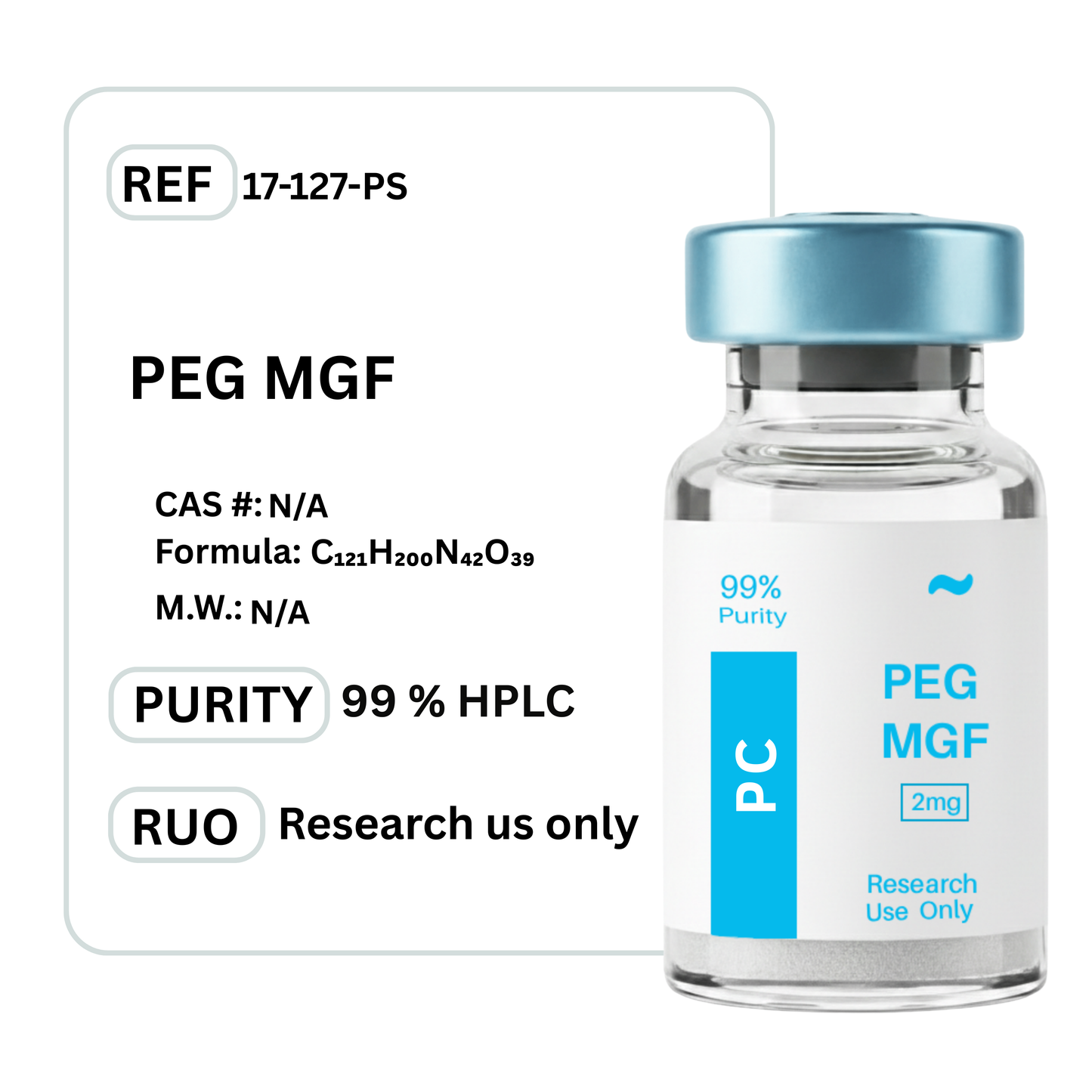
PEG MGF
PEG MGF is a structurally modified, pegylated form of Mechano-Growth Factor (MGF), a naturally occurring splice variant derived from the Insulin-like Growth Factor-1 (IGF-1) gene. The key feature is the attachment of a polyethylene glycol (PEG) chain, a process that significantly increases the peptide’s stability and lengthens its systemic circulation time. This modification is crucial for achieving sustained biological activity under controlled experimental conditions. This product is strictly formulated for research and analytical use and is not intended for therapeutic, clinical, or human applications.
PEG MGF Overview
PEG MGF (Pegylated Mechano-Growth Factor) is a synthetic analogue created to enhance the pharmacokinetic profile of the native MGF peptide, a splice variant of the Insulin-like Growth Factor-1 (IGF-1) gene. The modification involves pegylation—the addition of a polyethylene glycol (PEG) chain—which provides robust resistance to degradation and extends the molecule's circulating half-life dramatically.
This extended duration of action makes PEG MGF highly valuable for researchers studying fundamental processes that require sustained cellular signaling. Its applications include investigations into muscle tissue repair, growth factor-mediated signaling, the mechanics of cellular recovery, and the regulation of muscle hypertrophy. The prolonged bioactivity allows for a more thorough analysis of the peptide’s influence on satellite cell mobilization and tissue adaptation following mechanical stress.
PEG MGF is strictly intended for laboratory-based research and analytical applications. It is not approved for human or veterinary use and must be handled and utilized exclusively by qualified scientific professionals within controlled research environments.
PEG MGF Structure
PEG MGF Research
Study Focus
Key Mechanism of Action
Sustained Activity Benefit
Skeletal Muscle Repair
Mitigates oxidative stress and inflammation, regulates immune cell response, activates IGF-1 receptor.
Allows for analysis of long-term regenerative and anti-catabolic effects.
Myocardial Regeneration
Inhibits hypoxia-induced apoptosis, recruits cardiac stem cells to the injury site.
Supports prolonged study of heart function improvement and minimized pathological remodeling.
Cartilage Maintenance
Promotes chondrocyte function and migration, supporting tissue synthesis.
Extended half-life (weeks to months) facilitates sustained research on joint health.
Periodontal Tissue
Enhances osteogenic differentiation (bone formation) and upregulates tissue remodeling enzymes (MMP-1/2).
Relevant for long-term studies on ligament and bone regeneration around teeth.
PEG-MGF and Skeletal Muscle
Skeletal muscle injury triggers complex inflammatory and regenerative responses. Experimental data from mouse models suggest that local MGF injection protects muscle cells by reducing oxidative stress and lowering inflammatory hormone expression. Complementary findings indicate that MGF regulates inflammation and enhances the localized recruitment of immune cells, such as neutrophils and macrophages, critical for tissue cleanup. Research confirms MGF's ability to activate the insulin-like growth factor 1 (IGF-1) receptor comparably to IGF-1. Consequently, PEG-MGF is a tool for researchers investigating IGF-1-like actions that promote muscle regeneration, maintenance, and repair mechanisms.
PEG-MGF Research in Heart Muscle Repair
Research conducted by the Department of Bioengineering at the University of Illinois demonstrated that MGF can inhibit the programmed cell death of cardiac muscle cells caused by oxygen deprivation (hypoxia). The peptide also shows promise in attracting cardiac stem cells to damaged tissue, a factor critical for regeneration post-myocardial infarction. In rat experiments, MGF treatment reduced cell death and increased stem cell recruitment. Supporting research shows that localized PEG-MGF delivery can enhance post-injury cardiac performance by minimizing pathologic hypertrophy. Treated rats exhibited improved heart function and reduced structural remodeling of cardiac tissue.
Protecting Cartilage
MGF is implicated in enhancing the function of chondrocytes, the cells responsible for cartilage production. Animal research suggests MGF promotes the migration of chondrocytes from bone to cartilage regions, aiding regenerative processes. The extended half-life of PEG-MGF, which can sustain activity for weeks or months, is a significant advantage over native MGF, making it particularly useful for long-term studies on damaged joints and cartilage repair.
Dental Applications
In vitro studies using human periodontal ligament cell cultures have demonstrated that PEG-MGF enhances osteogenic (bone-forming) differentiation and increases the expression of critical tissue remodeling enzymes, MMP-1 and MMP-2. These effects suggest a potential for regenerating the ligaments connecting teeth to bone, which could provide avenues for retaining natural teeth following trauma or aiding in the restoration of surgically re-implanted teeth.
Article Author
This literature review was compiled, edited, and organized by Dr. Geoffrey Goldspink, Ph.D. Dr. Goldspink is a highly respected molecular physiologist, best known for the identification of Mechano-Growth Factor (MGF), an important splice variant of the Insulin-like Growth Factor-1 (IGF-1) gene. His foundational studies established how mechanical stimuli modulate gene expression and drive tissue regeneration in muscle, bone, and cartilage. Dr. Goldspink's career contributions are central to the fields of growth factor biology, regenerative science, and muscle repair, especially regarding the therapeutic potential and mechanisms of MGF and its modified forms like PEG-MGF.
Scientific Journal Author
Dr. Geoffrey Goldspink, Ph.D., Professor Emeritus of Muscle and Molecular Physiology at University College London (UCL), has published extensive peer-reviewed research defining the biological roles of Mechano-Growth Factor (MGF) in muscle adaptation, regeneration, and cellular signaling. Working with collaborators including Y. Li, P. Williams, and V. Kandalla, Dr. Goldspink has been crucial in characterizing the molecular pathways that link MGF to tissue growth, receptor activation, and repair. This acknowledgment is intended solely to credit the scientific achievements of Dr. Goldspink and his colleagues and is not an endorsement or promotion of this product.
Reference Citations
- Yang S, Cui H, Chai X, et al. Mechano growth factor, a splice variant of IGF-1, promotes neurogenesis in the aging mouse brain. Mol Brain. 2017;10:23.
- Vassilopoulos A, Constantinou C, Clayton R, et al. MGF: a local growth factor or a local tissue repair factor? Physiology (Bethesda). 2010;25:139-149.
- Goldspink G, Li Y, Williams P, et al. Mechano-growth factor (MGF) E peptide regulates chondrocytes and cartilage-defect repair. J Orthop Res. 2023 (review).
- Kandalla PK, Goldspink G, Mouly V, Butler-Browne G. Mechano-Growth Factor E peptide derived from an isoform of IGF-1 activates human muscle progenitor cells. Mech Ageing Dev. 2011;132(4):154-162.
- Core Peptides. PEG-MGF peptide: research in tissue repair and cell regeneration. 2023.
- HHM Global. Pegylated Mechano-Growth Factor peptide overview. 2024.
- Swolverine Blog. PEG-MGF for beginners: muscle repair, dosing, and stacking guide. 2024.
- TRT MD. PEG-MGF (Pegylated Mechano Growth Factor) - muscle repair and growth. 2024.
- Clinical research database. Study of MGF analogues in muscle repair. ClinicalTrials.gov.
ALL ARTICLES AND PRODUCT INFORMATION PROVIDED ON THIS WEBSITE ARE FOR INFORMATIONAL AND EDUCATIONAL PURPOSES ONLY.
The products offered on this website are furnished for in vitro studies only. In vitro studies (Latin: in glass) are performed outside of the body. These products are not medicines or drugs and have not been approved by the FDA to prevent, treat or cure any medical condition, ailment or disease. Bodily introduction of any kind into humans or animals is strictly forbidden by law.
STORAGE
Storage Instructions
All products are processed through lyophilization (freeze-drying), which is a stabilization method that supports shipping stability for approximately three to four months.
Peptide State
Condition
Temperature Requirement
Maximum Stability Period
Lyophilized (Long-Term)
Deep Freeze
-80C (-112F)
Several Months to Years
Lyophilized (Short-Term)
Refrigerated or Room Temp
Below 4C (39F) or Ambient
Several Weeks
Reconstituted Solution
Refrigerated
Below 4C (39F)
Up to 30 Days
Upon reconstitution with bacteriostatic water, the peptide solution requires refrigeration to preserve its effectiveness, maintaining stability for up to 30 days. Lyophilization, or cryodesiccation, is a specialized process where freezing and low pressure cause water to sublimate, leaving a stable, crystalline powder that can be safely kept at room temperature prior to mixing. For long-term storage (many months to years), freezing at -80C (-112F) is recommended to ensure the highest level of stability and structural integrity. Upon receipt, keep peptides cool and shielded from light. Short-term use is accommodated by refrigeration below 4C (39F).
Best Practices For Storing Peptides
Proper storage is critical to ensure the accuracy and reliability of laboratory research. Correct procedures prevent degradation, oxidation, and contamination, maximizing the peptide's effective lifespan.
Upon receipt, keep peptides cool and protected from light. For short-term needs (days to months), refrigeration below 4C (39F) is sufficient. Lyophilized peptides generally remain stable at room temperature for several weeks, making this suitable for brief storage periods. For optimal long-term preservation (several months to years), store peptides in a freezer at -80C (-112F). Minimize freeze-thaw cycles, as temperature fluctuations hasten degradation. Avoid frost-free freezers due to the temperature variations that occur during their automatic defrost cycles, which can compromise peptide stability.
Preventing Oxidation and Moisture Contamination
Stability requires protecting peptides from air and moisture. To avoid moisture contamination, which is common when a cold vial is opened, always allow the peptide container to reach room temperature before opening it after removal from the freezer. Minimize air exposure by keeping the container closed as much as possible and promptly resealing it after dispensing. Storing the remaining peptide under a dry, inert gas (such as nitrogen or argon) can further prevent oxidation. Peptides containing cysteine (C), methionine (M), or tryptophan (W) residues are especially sensitive to air oxidation. To maintain long-term integrity, aliquot the peptide into smaller portions for individual experimental use, preventing repeated handling, temperature changes, and exposure to air.
Storing Peptides In Solution
Peptide solutions have a significantly shorter shelf life and are more vulnerable to bacterial degradation. Peptides containing cysteine (Cys), methionine (Met), tryptophan (Trp), aspartic acid (Asp), glutamine (Gln), or N-terminal glutamic acid (Glu) residues degrade quickly in solution. If solution storage is necessary, use sterile buffers with a pH between 5 and 6. Aliquot the solution to minimize detrimental freeze-thaw cycles. Most peptide solutions remain stable for up to 30 days when refrigerated at 4C (39F). Less stable peptides should be frozen when not in immediate use.
Peptide Storage Containers
Containers must be clean, clear, durable, and chemically resistant, and appropriately sized to minimize air space. Both glass and plastic vials are suitable. Polystyrene plastic is clear but less chemically resistant, while polypropylene plastic is more chemically resistant but often translucent. High-quality glass vials offer the best overall characteristics for stability and inertness. Although peptides are often shipped in plastic to prevent breakage, they can be safely transferred to glass vials for specific long-term storage or handling requirements.
Peptide Storage Guidelines: General Tips
Adherence to these best practices is crucial for preventing degradation and maintaining stability:
- Store peptides in an environment that is cold, dry, and dark.
- Avoid repeated freeze-thaw cycles.
- Minimize air exposure to reduce the risk of oxidation.
- Protect peptides from light.
- Do not store peptides in solution long term; keep them lyophilized whenever possible.
- Aliquot peptides based on experimental needs to limit unnecessary handling.