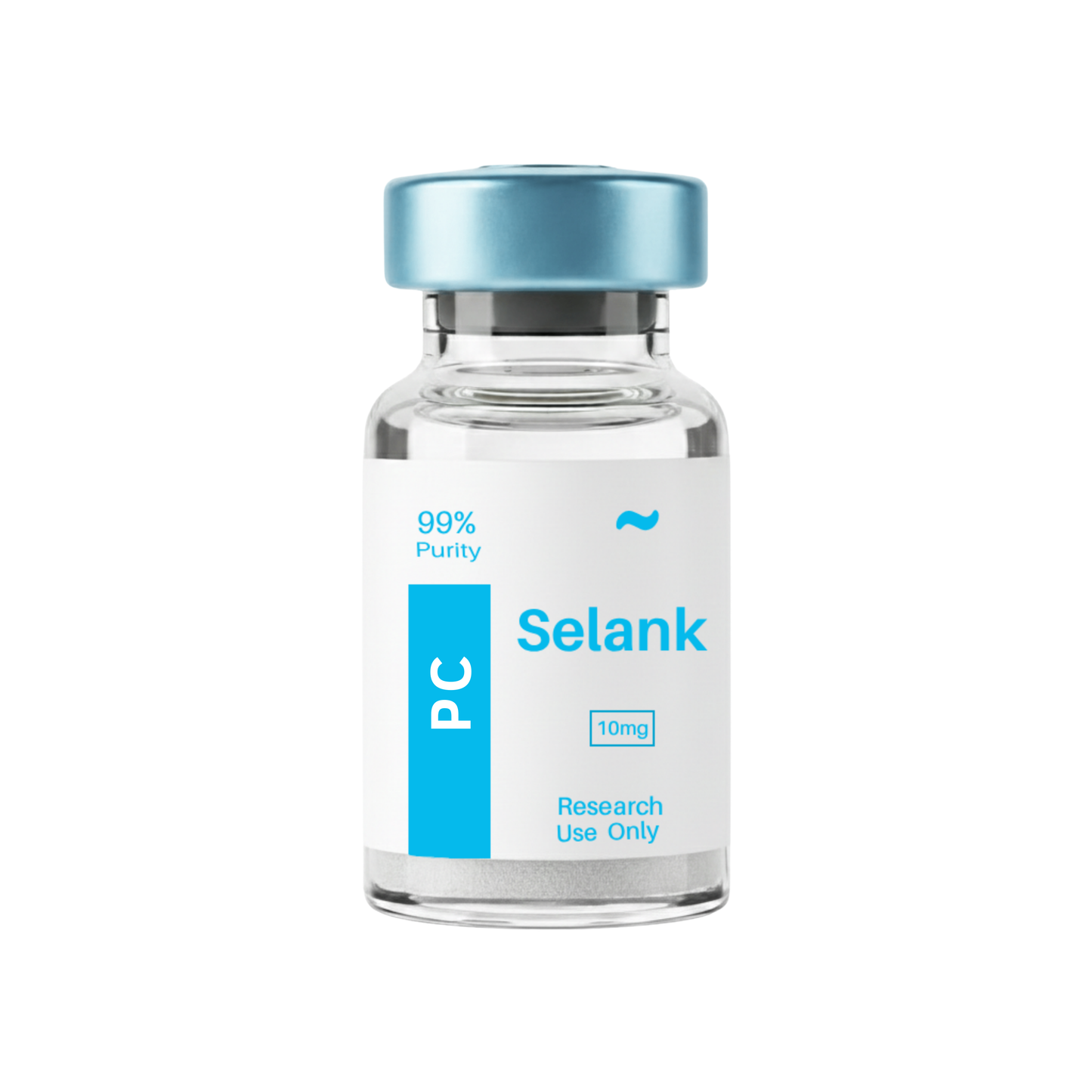
Selank Peptide - 5 mg
Selank is a short, synthetic analogue of the naturally occurring immunomodulatory peptide Tuftsin. It has been the focus of extensive research for its potent anxiolytic (anti-anxiety), neuroprotective, and cognitive-enhancing effects. This product is supplied as a research-grade preparation of high purity lyophilized powder in a 5 mg vial, formulated for exceptional chemical stability and extended shelf-life critical for rigorous laboratory research.
Product is supplied as a lyophilized powder. Intended for qualified scientific research only. Not for human or animal consumption.
Selank Peptide Overview
Selank is a synthetic heptapeptide that originated in Russian scientific research, primarily studied for its strong nootropic and anxiolytic activities. It serves as an artificial structural analogue of the endogenous peptide Tuftsin, which is known to influence the immune system by modulating T helper cell activity, regulating the expression of inflammatory cytokines (e.g., IL-6), and interacting with critical neurochemical systems, including monoamine pathways and the regulation of BDNF.
The chemical structure of Selank is derived from Tuftsin but includes four specific amino acid additions. This modification was implemented to achieve superior metabolic resistance and a significantly prolonged functional half-life, enhancing its utility in extended research models. Scientific literature, including preclinical and human pilot studies, has investigated Selank's potential in the context of generalized anxiety and cognitive disorders.
Selank Structure
Property
Value
Purity
98.0% percent minimum
Formulation
Lyophilized Powder
Grade
Research Grade (For in-vitro and non-human research applications)
Sequence
Thr-Lys-Pro-Arg-Pro-Gly-Pro
Molecular Formula
C33 H57 N11 O9
Molecular Weight
751.87 g/mol
CAS Number
129954-34-3
Synonyms
Selanc
Structure Solution Formula
Threonyl-Lysyl-Prolyl-Arginyl-Prolyl-Glycyl-Proline
Selank Research
Anxiolysis, GABA Pathway, and Safety Profile
Selank consistently demonstrates robust anti-anxiety and neuroprotective effects. Its mechanism involves the modulation of GABAA receptors, thereby enhancing the inhibitory action of the neurotransmitter GABA. Studies indicate that Selank can reduce anxiety, stabilize mood, lessen the impact of stress, and support memory and learning processes. Low experimental doses have been observed to exert a mild calming effect. A key finding is that research suggests Selank does not appear to pose the risks of physical dependence, withdrawal, or memory impairment associated with many conventional psychotropic medications.
In animal models, detailed gene expression analysis indicates Selank's influence on genetic activity within the GABA signaling pathways. It significantly affects 7 genes and moderately alters 45 genes out of 84 associated with the GABA system. This suggests the peptide can modify gene expression within neurons, potentially by altering the functional affinity of the GABAA receptor for GABA, a critical pathway for co-administration studies.
Comparative rat studies demonstrate Selank's anxiolytic efficacy is similar to that of benzodiazepines, particularly in generalized anxiety models. The most effective mitigation of chronic mild stress symptoms was achieved through the combination of both treatments.
Enkephalin Regulation, Pain, and Stress
A key proposed mechanism of Selank’s anti-anxiety action is the inhibition of enkephalinase, the enzyme responsible for the metabolic deactivation of enkephalins. Enkephalins are endogenous peptides with natural analgesic and anti-stress properties. Researchers have correlated elevated enkephalinase activity with increased anxiety in some subjects. By inhibiting enkephalinase, Selank may help re-establish enzymatic balance, thereby protecting the body's natural anti-anxiety and analgesic peptides.
Immunomodulation and Asthenic Symptoms
Research in depressed subjects has shown Selank’s ability to suppress the gene responsible for the production of the inflammatory cytokine IL-6. This immunoregulatory effect is particularly relevant for research into anxiety-asthenic disorders, which are characterized by anxiety coupled with debilitating physical symptoms like chronic fatigue, pain, and physiological instability.
Selank is comparable to benzodiazepines in reducing core anxiety symptoms, but it is uniquely distinguished by its capacity to also alleviate associated asthenic symptoms. This benefit is hypothesized to stem from its dual action in regulating IL-6 expression and protecting enkephalins from degradation.
Further rat studies show Selank modulates the expression of approximately 34 genes related to inflammation, including chemokines and cytokines. Its influence on the expression of Bcl6, a gene vital for immune system development, confirms its broad biological activity for immunological investigation.
Cognitive Enhancement and Neuroplasticity
Given the well-established link between high anxiety and compromised cognitive function, Selank’s observed ability to directly enhance memory and learning is a central focus of research. This cognitive benefit appears to be independent of its anxiolytic effects.
In animal models, Selank administration significantly strengthened memory trace stability, reinforcing the process of memory storage regardless of the subjects’ baseline anxiety levels.
Selank is hypothesized to influence memory by modifying gene expression within the hippocampus. Studies document changes in mRNA levels for 36 genes in this memory-critical region, many of which encode plasma membrane proteins involved in ion-dependent processes essential for learning and memory.
Additionally, Selank has been shown to support the recovery of memory and learning abilities following traumatic brain injury in experimental models. This effect, hypothesized to be linked to the transient inhibition of the brain’s catecholamine system, suggests potential research in the field of neurorehabilitation.
Research Guidelines: While animal studies suggest minimal side effects and effective subcutaneous absorption, it is critical to remember that animal data are not directly transferable to human clinical practice. This product is intended strictly for scientific and educational research use.
Article Author and Scientific Recognition
Article Author
This review is based on the foundational scientific work of Dr. Ivan P. Ashmarin, Ph.D. Dr. Ashmarin is a distinguished neurochemist, widely recognized for his pioneering research on Tuftsin analogues, including his direct contribution to the initial development and scientific characterization of Selank. His early work established the critical research paradigm for studying its neuroprotective and anxiolytic properties.
Scientific Journal Recognition
Dr. Ashmarin's extensive research, often in collaboration with leading scientists (L.A. Andreeva, A.E. Medvedev, and others), has been instrumental in advancing the scientific understanding of Selank's biological actions on the GABAergic system, neurotrophic signaling, and immune system regulation.
This section serves solely to acknowledge the scientific work cited. It must not be interpreted as an endorsement, promotion, or indication of professional affiliation between our company and Dr. Ashmarin or the collaborating researchers.
Reference Citations
Ashmarin IP, et al. Tuftsin analogs in neuropeptide research: Selank development. Neurochem J. 2008;2(3):173–180. https://pubmed.ncbi.nlm.nih.gov/19565835/
Andreeva LA, et al. Selank's anxiolytic effect compared to benzodiazepines. Bull Exp Biol Med. 2008;145(3):347-350. https://pubmed.ncbi.nlm.nih.gov/19145399/
Medvedev AE, et al. Selank and modulation of GABAergic activity. Neurochem Res. 2017;42(10):2801-2808. https://pubmed.ncbi.nlm.nih.gov/28842767/
Kopeikina E, et al. Selank-induced BDNF expression and neuroprotection. Neurochem Int. 2019;128:21-27. https://pubmed.ncbi.nlm.nih.gov/31154050/
Dolotov OV, et al. Selank modulation of serotonin metabolism. Neurosci Lett. 2018;678:79-84. https://pubmed.ncbi.nlm.nih.gov/30359660/
Kovaleva ES, et al. Selank's immunomodulatory and antiviral activity. Dokl Biochem Biophys. 2012;443:72-76. https://pubmed.ncbi.nlm.nih.gov/23070720/
Inozemtseva LS, et al. Neuroprotective effects of Selank in experimental models. Bull Exp Biol Med. 2017;162(4):455–459. https://pubmed.ncbi.nlm.nih.gov/28447725/
Kudrin VS, et al. Impact of Selank on monoamine metabolism. Neurochem J. 2010;4(4):39-45. https://pubmed.ncbi.nlm.nih.gov/20823844/
Semenova TP, et al. Selank improves memory and cognitive function in animal studies. Bull Exp Biol Med. 2015;159(5):640-643. https://pubmed.ncbi.nlm.nih.gov/26601986/
Kolesnikova TO, et al. Pharmacokinetics of Selank in rodent models. Pharm Chem J. 2009;43:295-299. https://pubmed.ncbi.nlm.nih.gov/19662555/
IMPORTANT DISCLAIMER
All articles and product information provided on this website are for informational and educational purposes only. The products offered are strictly furnished for in-vitro studies only. In-vitro studies (Latin: in glass) are performed outside of the living body. These products are not classified as medicines or drugs and have not been evaluated or approved by the FDA to prevent, treat, or cure any medical condition, ailment, or disease. Introduction of any kind into humans or animals is strictly forbidden by law and is not the intended use of this product.
STORAGE
Storage Instructions
The product is manufactured through lyophilization (freeze-drying), a process that maximizes chemical stability and ensures integrity during shipping for approximately 3–4 months.
Upon reconstitution with an appropriate solvent (e.g., bacteriostatic water), the peptide solution must be stored under refrigeration to maintain its effectiveness. Peptide solutions are generally stable for up to 30 days when refrigerated.
Lyophilization involves freezing the peptide followed by exposure to reduced pressure, which forces the water to sublimate (a direct phase change from solid to vapor). This yields a stable, crystalline powder that can be safely held at room temperature for short durations before use.
For long-term storage over many months or years, the ideal condition is ultra-low temperature freezing at -80 degrees C (-112 degrees F). This optimal cold condition is crucial for preserving the peptide’s structural integrity and ensuring long-term research reliability.
Upon receiving the product, it must be stored in a cool, dark environment. For short-term use (days to months), refrigeration at less than 4 degrees C (39 degrees F) is suitable. Lyophilized powders are stable enough for short-term room temperature storage (several weeks).
Best Practices For Storing Peptides
Strict adherence to storage guidelines is paramount for ensuring accurate and reproducible research results. Proper storage mitigates degradation, oxidation, and contamination.
- Short-Term Storage: Peptides should be protected from light and kept cool. For use spanning several months, refrigeration at $<4$ degrees C (39 degrees F) is recommended. Minimal short-term room temperature storage is acceptable for lyophilized powders (a few weeks).
- Long-Term Storage: For preservation spanning months to years, peptides must be stored in an ultra-cold -80 degrees C (-112 degrees F) freezer.
- Mitigate Temperature Stress: Minimize repeated freeze-thaw cycles to prevent accelerated degradation. Avoid using frost-free freezers, as their auto-defrost cycles introduce detrimental temperature fluctuations.
Preventing Oxidation and Moisture Contamination
It is essential to protect peptides from environmental damage, especially air and moisture. To prevent moisture contamination (condensation) when removing a cold vial from the freezer, always allow the container to reach room temperature before opening it.
Minimize air exposure by keeping the container sealed whenever possible and promptly resealing it after withdrawal. Storing the remaining peptide under a dry, inert gas (such as nitrogen or argon) can help prevent air oxidation, which is particularly important for sensitive residues (C, M, W).
For optimal long-term stability, it is strongly recommended to divide the total peptide quantity into smaller, single-use aliquots before freezing. This prevents the entire stock from repeated temperature changes and handling.
Storing Peptides In Solution
Peptide solutions have a significantly shorter shelf life and are highly susceptible to degradation. Peptides with certain residues (Cys, Met, Trp, Asp, Gln, or N-terminal Glu) degrade faster in solution.
If solution storage is unavoidable, use sterile buffers with a stable pH (5–6). Immediate aliquoting is necessary to minimize freeze-thaw cycles. Under refrigeration at 4 degrees C (39 degrees F), most solutions are stable for up to 30 days. Unstable peptides should be frozen until immediately needed.
Peptide Storage Containers
Storage vessels must be clean, transparent, durable, and chemically inert. They should be appropriately sized to minimize excess air space. High-quality glass vials are preferred for optimal chemical stability, though plastic vials are often used for shipping. Transfer between container types is safe as required by experimental needs.
Peptide Storage Guidelines: General Tips
Adhere to these best practices for maintaining peptide integrity:
- Store in a cold, dry, and dark environment.
- Eliminate freeze-thaw cycles.
- Minimize exposure to air and light.
- Avoid long-term storage in solution.
- Aliquoting is essential to protect the bulk stock.