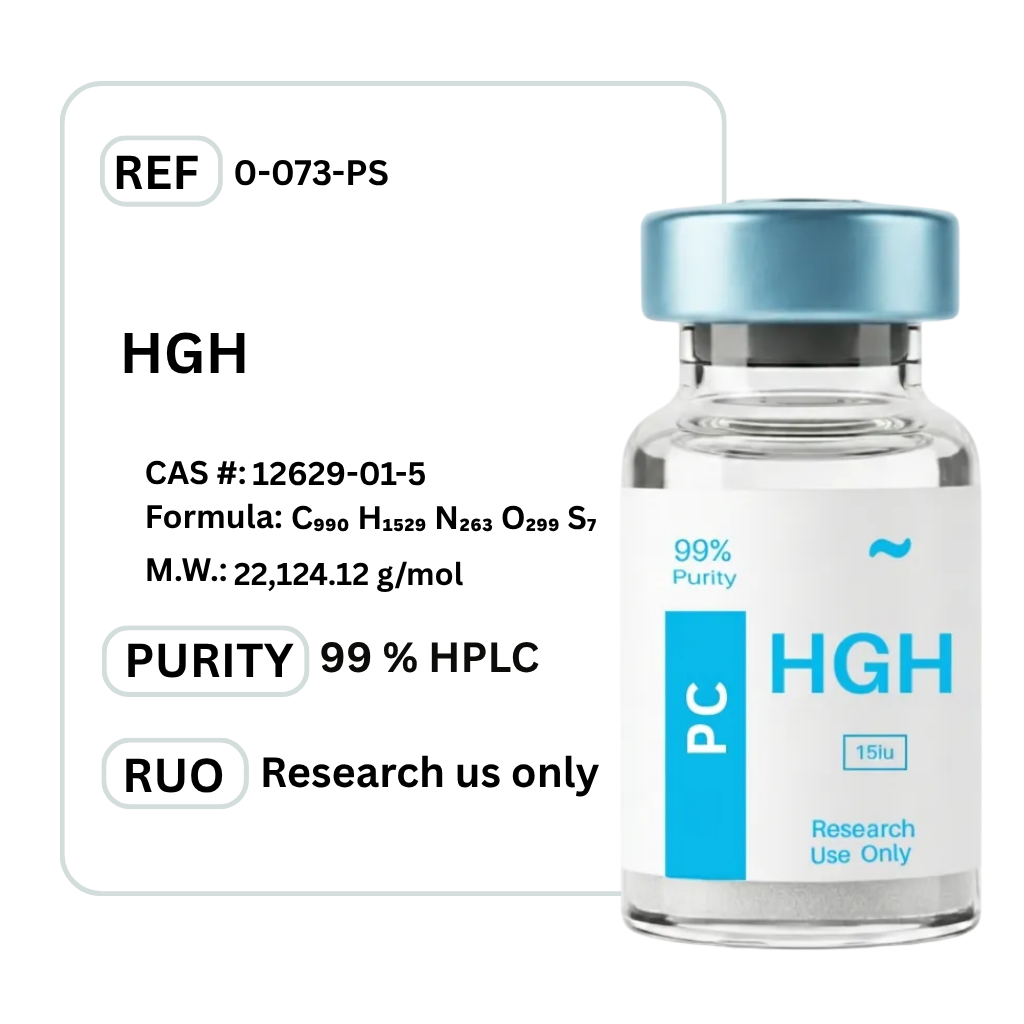
HGH (Human Growth Hormone)
HGH (Somatropin) is a recombinant protein made up of 191 amino acids, and its structure is perfectly identical to the human growth hormone naturally secreted by the anterior pituitary gland. With an approximate molecular weight of 22 kDa, it acts by binding to growth hormone receptors to govern growth, body composition, and intermediary metabolism. In research, its potency is often standardized and quantified in International Units (IU) based on the WHO/Ph. Eur. standard, where 1 mg of anhydrous somatropin is conventionally equivalent to approximately 3.0 IU of biological activity.
HGH (Human Growth Hormone) Overview
Somatropin initiates its biological cascade by binding to growth hormone receptors, a process that promotes receptor dimerization and subsequent activation of the JAK2/STAT signaling pathway. This pathway is a critical step in driving gene transcription across various target tissues. Most of its systemic effects are indirectly mediated through the stimulation of insulin-like growth factor-1 (IGF-1), which occurs both in the liver (hepatic) and in peripheral tissues. HGH research has explored its influence on protein synthesis, fat breakdown, carbohydrate and lipid metabolism, fluid regulation, and bone remodeling. The International Unit (IU) measurement for somatropin standardizes its biological activity across different batches. According to the WHO standard, 3 IU is conventionally equivalent to 1 mg of somatropin, providing consistency for research formulations.
HGH (Human Growth Hormone) Structure
Chemical Makeup
- Molecular Weight: Approximately 22 kDa (191 amino acids)
- Amino Acid Count: 191
- Other Known Titles: Somatropin; Human growth hormone
- CAS: 12629-01-5 (Somatropin)
HGH (Human Growth Hormone) Research
Adult Growth Hormone Deficiency (AGHD) and Body Composition
Randomized clinical trials and systematic reviews involving adults with growth hormone deficiency have consistently demonstrated that GH replacement therapy leads to a significant reduction in total and abdominal fat mass and a corresponding increase in lean body mass. While improvements in lipid profiles and patient-reported quality-of-life indicators are frequently observed, these benefits are sometimes accompanied by dose-related fluid retention.
Dosing Principles in Research Settings
Research guidelines for AGHD stress the importance of individualized dose titration. Dosing is guided by IGF-1 targets and observed clinical outcomes, taking into account differences in GH sensitivity based on sex and age. The common approach is to start with low doses and gradually adjust them to achieve optimal biomarker and body-composition results while minimizing common dose-related side effects such as joint pain or edema.
Article Author
This literature review was compiled, edited, and organized by Dr. Michael J. Waters, Ph.D. Dr. Waters is an internationally recognized molecular endocrinologist renowned for his pioneering research on growth hormone (GH) receptor structure, signaling mechanisms, and physiological regulation. His contributions have profoundly shaped the modern understanding of GH receptor dimerization, JAK2/STAT pathway activation, and the downstream modulation of IGF-1 synthesis and metabolic processes.
Scientific Journal Author
Dr. Michael J. Waters, together with Dr. Andrew J. Brooks, has published extensive work on GH receptor biology, including detailed mechanistic insights into receptor activation and intracellular signaling. Their collaborative research has been instrumental in defining the molecular events linking GH binding to JAK2 activation and subsequent transcriptional regulation. Complementary findings from Dr. J.B. Deijen and colleagues, published in the European Journal of Endocrinology, further elucidate the clinical outcomes of GH replacement therapy—demonstrating significant reductions in fat mass, increases in lean body mass, and improvements in quality-of-life parameters among adults with GH deficiency. This citation is intended solely to recognize the scientific contributions of Dr. Waters, Dr. Brooks, Dr. Deijen, and their collaborators. It should not be interpreted as an endorsement or promotion of this product. Montreal Peptides Canada has no affiliation, sponsorship, or professional relationship with these researchers or the institutions cited.
Reference Citations
U.S. FDA - Humatrope (somatropin) label. Identity and product description. https://www.accessdata.fda.gov/drugsatfda_docs/label/20 24/020280s092lbl.pdf USP/Ph. Eur. convention: "Somatropin for Injection" monograph-1 mg anhydrous somatropin 3.0 IU. https://www.uspbpep.com/ep6 O/somatropin%20for%20injection%200952e.pdf EDQM/WHO standardization note: Specific activity 3.0 IU per mg adopted for somatropin. https://www.edqm.eu/documents/52006/123 862/bsp004-somatropin-crs1.pdf/759a6c11-3085-1a6b-ffc4-c53795afb1b6 FDA - Nutropin (somatropin) label: Example vials showing ~30 IU per 10 mg (3 IU/mg convention). https://www.accessdata.fda.gov/dr ugsatfda_docs/label/2007/019676s030%2C020522s033lbl.pdf Waters MJ, Brooks AJ. "JAK2 activation by growth hormone receptor." Growth Horm IGF Res 2015 - mechanistic overview. https://ww w.sciencedirect.com/science/article/pii/S1096637415000180 Deijen JB et al. / Systematic review (European Journal of Endocrinology): GH replacement decreases fat mass and increases lean mass; QoL signals reported. https://academic.oup.com/ejendo/article-abstract/166/1/13/6659269
STORAGE
Storage Instructions
All products are produced through a lyophilization (freeze-drying) process, which preserves stability during shipping for approximately 3–4 months. After reconstitution with bacteriostatic water, peptides must be stored in a refrigerator to maintain their effectiveness. Once mixed, they remain stable for up to 30 days. Lyophilization, also known as cryodesiccation, is a specialized dehydration method in which peptides are frozen and exposed to low pressure. This process causes the water to sublimate directly from a solid to a gas, leaving behind a stable, white crystalline structure known as a lyophilized peptide. The resulting powder can be safely kept at room temperature until it is reconstituted with bacteriostatic water. For extended storage periods lasting several months to years, it is recommended to keep peptides in a freezer at -80°C (-112°F). Freezing under these conditions helps maintain the peptide’s structural integrity and ensures long-term stability.
Best Practices For Storing Peptides
Proper storage of peptides is critical to maintaining the accuracy and reliability of laboratory results. Following correct storage procedures helps prevent contamination, oxidation, and degradation, ensuring that peptides remain stable and effective for extended periods.
- Lyophilized Storage: For long-term preservation over several months or years, peptides should be stored in a freezer at -80°C (-112°F). For short-term use, refrigeration below 4°C (39°F) is suitable.
- Avoid Fluctuations: Avoid repeated freeze-thaw cycles, as they can accelerate degradation. Additionally, frost-free freezers should be avoided due to temperature variations during defrosting.
Preventing Oxidation and Moisture Contamination
It is essential to protect peptides from exposure to air and moisture, as both can compromise their stability.
- Handling: To avoid condensation, always allow the cold vial to reach room temperature before opening. Minimize air exposure by promptly resealing the container.
- Sensitive Peptides: Peptides containing cysteine (C), methionine (M), or tryptophan (W) residues are especially sensitive to air oxidation and should be handled with extra care.
- Aliquot: To preserve long-term stability, divide the total peptide quantity into smaller aliquots for individual experimental use to prevent repeated exposure.
Storing Peptides In Solution
Peptide solutions have a significantly shorter shelf life compared to lyophilized forms and are more susceptible to bacterial degradation.
- Reconstituted Stability: Under refrigerated conditions at 4°C (39°F), most peptide solutions remain stable for up to 30 days.
- Buffer/pH: If storage in solution is unavoidable, it is recommended to use sterile buffers with a pH between 5 and 6.
- Sensitive Peptides: Peptides containing cysteine, methionine, tryptophan, aspartic acid, glutamine, or N-terminal glutamic acid residues tend to degrade more rapidly when stored in solution and should be frozen when not in immediate use.
Peptide Storage Containers
High-quality glass vials provide the best overall characteristics for peptide storage, offering clarity, stability, and chemical inertness, though plastic containers are often used for shipping. Containers should be appropriately sized to minimize excess air space.