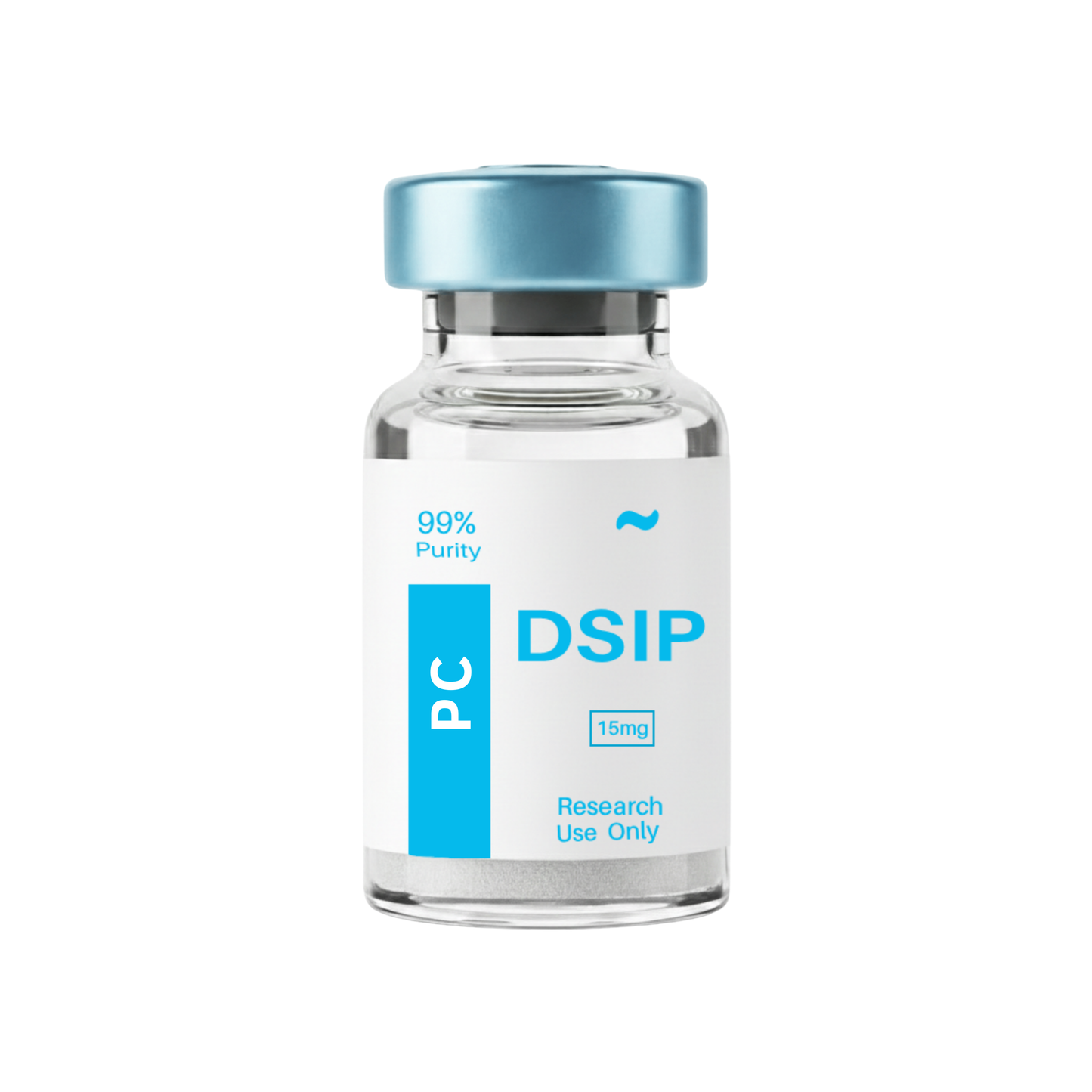
DSIP (Delta Sleep‑Inducing Peptide)
DSIP (Delta Sleep‑Inducing Peptide) is an endogenous nonapeptide first isolated from mammalian brain tissue and cerebrospinal fluid, historically linked to the promotion of deep non‑REM (slow‑wave) sleep and enhanced delta‑frequency EEG activity. Its amino‑acid sequence is:
Trp‑Ala‑Gly‑Gly‑Asp‑Ala‑Ser‑Gly‑Glu
DSIP has been extensively investigated as a neuromodulatory factor in sleep regulation, neuroendocrine signaling, circadian timing, and stress adaptation. Because its primary receptor(s) and direct molecular targets remain only partially defined, DSIP is used primarily as a research tool to explore how short regulatory peptides influence brain electrical activity, hypothalamic–pituitary output, and CNS homeostasis.
DSIP provided by Montreal Peptides Canada is a high‑purity, lyophilized peptide intended strictly for laboratory and scientific research use. It is not approved for human or veterinary administration, diagnosis, treatment, or consumption.
DSIP Overview
DSIP was originally identified as a brain‑derived factor capable of enhancing delta‑wave (0.5–4 Hz) activity and promoting deep, restorative sleep. Since then, it has been studied across multiple domains:
- Sleep architecture and EEG modulation
Used to investigate changes in sleep onset latency, consolidation of slow‑wave sleep (SWS), delta EEG power, and rebound after sleep disruption. - Circadian and neuroendocrine regulation
Employed in models probing how sleep stages interact with circadian hormone rhythms, including context‑dependent effects on growth hormone (GH), ACTH, prolactin, and other pituitary hormones. - Stress and HPA‑axis function
Applied in stress paradigms to study peptide‑mediated modulation of the hypothalamic–pituitary–adrenal (HPA) axis, as well as behavioral and autonomic responses to stressors. - Broader neuromodulatory roles
Investigated for indirect interactions with GABAergic, glutamatergic, and monoaminergic systems, positioning DSIP as a probe for peptide contributions to CNS stability and excitatory–inhibitory balance.
Because DSIP’s direct molecular targets are still being clarified, it is particularly useful in exploratory and mechanistic work on peptide‑based regulation of integrated sleep and endocrine physiology.
DSIP Structure
Chemical Makeup
- Sequence: Trp‑Ala‑Gly‑Gly‑Asp‑Ala‑Ser‑Gly‑Glu
- Molecular Formula: C₃₅H₄₈N₁₀O₁₅
- Molecular Weight: ~849.82 Da
- Form: Lyophilized powder
- Appearance: White to off‑white powder
- Typical Analytical Characterization:
- Reverse‑phase HPLC (UV detection at ~214 nm)
- LC‑MS (ESI⁺ mode) confirmed against a synthetic DSIP reference standard
DSIP Research
Sleep Regulation and Delta‑Wave Activity
DSIP’s earliest and most prominent research application lies in sleep science:
- Slow‑wave sleep (SWS): DSIP has been associated with increases in delta EEG power and altered proportions of deep non‑REM sleep in select animal and human studies.
- Sleep onset and continuity: It is employed to assess effects on time to sleep onset, stability of SWS, and rebound sleep following deprivation.
- Integration with classical sleep systems: DSIP is often studied alongside GABAergic, serotonergic, and other sleep‑modulating pathways to clarify how peptidergic signals interface with established sleep circuitry.
These attributes make DSIP a useful tool for dissecting peptide contributions to slow‑wave promotion and EEG architecture.
Neuroendocrine and Pituitary Modulation
DSIP has also been used to probe hypothalamic–pituitary integration:
- Pituitary hormone secretion: Experimental paradigms have examined DSIP‑associated alterations in GH, ACTH, prolactin, LH, and other pituitary hormones under specific physiologic or pharmacologic conditions.
- Coupling to circadian rhythms: DSIP helps investigate how changes in sleep stages might relate to diurnal hormone profiles, especially nocturnal surges of pituitary hormones.
- Hypothalamic regulation: By acting at, or upstream of, hypothalamic centers, DSIP serves as a model for peptidergic adjustment of neuroendocrine feedback loops and set‑points.
Collectively, these lines of research position DSIP as a probe for sleep–hormone coupling and integrated endocrine control.
Stress Response, Autonomic Regulation, and CNS Stability
Beyond sleep and hormonal studies, DSIP is investigated in stress and CNS resilience models:
- HPA‑axis modulation: Used to assess DSIP’s impact on ACTH and glucocorticoid responses, as well as behavioral markers of stress and adaptation.
- Autonomic balance: Some studies evaluate DSIP influences on cardiovascular and autonomic measures, offering insight into potential modulation of sympathetic/parasympathetic tone.
- Neuroprotection and metabolism: Experimental work has explored possible roles for DSIP in limiting excitotoxic damage, mitigating oxidative stress, and affecting neuronal metabolic efficiency.
Although results are model‑ and context‑dependent, DSIP remains a candidate peptide for studying how short peptides support CNS and systemic homeostasis under stress.
Mechanistic and Receptor‑Level Studies
DSIP’s direct receptor(s) and signaling mechanisms are not fully established, making mechanistic work an active area of research:
- Receptor identification: DSIP is used to search for specific peptide GPCRs and to test whether its actions arise from direct receptor binding or indirect modulation of known transmitter systems.
- Signal‑transduction pathways: Investigations examine effects on second messengers, ion‑channel function, and phosphorylation states in neuronal and endocrine models.
- Structure–activity relationships: DSIP analogs, truncated fragments, and sequence variants help define which residues and motifs are critical for sleep, endocrine, or stress‑related effects.
These efforts aim to clarify how a relatively simple nonapeptide can exert complex physiological influences across multiple systems.
Article Author
This overview is presented in recognition of the pioneering work of Dr. M. Monnier, M.D., Ph.D., and colleagues who first isolated and characterized Delta Sleep‑Inducing Peptide. Their discovery that a discrete peptide fraction could enhance delta‑wave sleep and change EEG patterns established DSIP as a central tool compound in peptide‑based sleep and neuroendocrine research.
Scientific Journal Author
The original identification and structural determination of DSIP were accomplished by M. Monnier and collaborators, who:
- Isolated a brain‑derived peptide fraction with delta sleep‑inducing properties
- Determined the nonapeptide sequence now known as DSIP
- Described its ability to modify sleep staging and EEG architecture in experimental models
Later work by investigators such as V.M. Kovalzon, H. Möhler, and others expanded DSIP research into neurochemical mechanisms, receptor hypotheses, and applications in stress, circadian, and autonomic physiology.
This acknowledgment is provided solely to recognize the scientific contributions of these researchers and does not imply endorsement, sponsorship, or affiliation between Montreal Peptides Canada and any individuals or institutions mentioned.
Reference Citations (Representative)
Representative DSIP references include:
- Monnier M, et al. Isolation and structural characterization of delta sleep‑inducing peptide. Nature.
- Kovalzon VM. Delta sleep‑inducing peptide: 25 years of experimental and clinical research. Neurosci Biobehav Rev.
- Möhler H, et al. Peptidergic modulation of sleep by DSIP. Neuropharmacology.
- Kryger MH, Roth T, Dement WC, eds. Principles and Practice of Sleep Medicine. Sections on peptide‑based sleep modulators.
- Biochemical and pharmacologic databases (e.g., NCBI, PubChem) summarizing DSIP structure and known properties.
Researchers should consult primary literature databases (e.g., PubMed, Web of Science) for complete citations and up‑to‑date DSIP studies.
HPLC/MS
HPLC
Reverse‑phase high‑performance liquid chromatography (RP‑HPLC) with UV detection (typically at 214 nm) is used to assess DSIP purity:
- A chromatogram dominated by a single main peak corresponding to DSIP
- Low‑intensity secondary peaks only, consistent with minimal synthetic by‑products or degradation species
Each batch is benchmarked against a synthetic DSIP standard to ensure high and consistent purity.
MS
Mass spectrometric analysis (e.g., LC‑MS, ESI⁺ mode) confirms molecular identity:
- Detection of a molecular ion at a mass consistent with DSIP’s theoretical molecular weight (~849.8 Da)
- Absence of major additional ions indicative of truncations, sequence errors, or extensive degradation within the sensitivity of the assay
Combined HPLC/MS characterization verifies that DSIP meets structural and purity requirements for research use.
STORAGE
Storage Instructions
All DSIP products are manufactured using Lyophilization (Freeze Drying), which ensures that they remain fully stable during shipment for approximately 3–4 months.
After reconstitution with bacteriostatic water:
- Store the DSIP solution refrigerated at about 4°C (39°F).
- Under these conditions, DSIP typically remains stable for up to 30 days.
Lyophilization (cryodesiccation) is a specialized dehydration process in which:
- The peptide is frozen, and
- Exposed to low pressure, allowing water to sublimate directly from solid (ice) to gas.
This produces a stable, white crystalline (“fluffy”) lyophilized peptide that:
- Can usually be held at room temperature for limited periods before reconstitution
- Maintains integrity during normal shipping without continuous cold‑chain, provided it is used within the recommended timeframe
Upon receipt:
- Keep DSIP cool and protected from light.
- For peptides intended for near‑term use (days to a few months), storage at 4°C (39°F) is generally adequate.
- Lyophilized DSIP is typically stable at ambient temperature for several weeks, so short‑term room‑temperature storage is acceptable when use is planned soon.
For extended storage (several months to years):
- Store lyophilized DSIP at −80°C (−112°F).
- Deep‑freezing at −80°C is recommended for maintaining peptide stability over long timeframes.
Best Practices For Storing Peptides
To preserve DSIP quality and ensure reproducible results:
- Short‑term:
- Refrigerate at ≤4°C (39°F) for use within weeks to a few months.
- Long‑term:
- Store lyophilized peptide at −80°C (−112°F) for multi‑month to multi‑year preservation.
- Avoid frost‑free freezers:
- Automatic defrost cycles create temperature fluctuations that can degrade peptides.
- Minimize freeze–thaw cycles:
- Repeated freezing and thawing can damage peptide structure and reduce activity.
- Protect from light and moisture:
- Store in dark, dry conditions to reduce photodegradation and hydrolysis.
These practices apply to DSIP and most other research‑grade peptides.
Preventing Oxidation and Moisture Contamination
Oxidation and moisture exposure can significantly compromise peptide stability:
- Condensation:
- When removing frozen vials from storage, allow them to warm to room temperature before opening to prevent condensation inside the vial.
- Air exposure:
- Open vials as briefly as possible and reseal tightly after withdrawing the desired amount.
- Optional inert gas overlay:
- For long‑term storage, consider flushing the vial headspace with nitrogen or argon to minimize oxidative processes.
- Aliquoting:
- Divide DSIP into small, single‑use or limited‑use aliquots to avoid repeated exposure of the entire stock to air and temperature shifts.
These steps help maintain peptide integrity over multiple experiments.
Storing Peptides In Solution
Compared with lyophilized powder, peptide solutions are more susceptible to degradation and contamination:
- Buffer selection:
- Use sterile buffers with a pH typically in the 5–6 range, unless specific protocols dictate otherwise.
- Aliquot solutions:
- Prepare small aliquots of reconstituted DSIP to reduce repeated freeze–thaw cycles.
- Refrigerated stability:
- At 4°C (39°F), most peptide solutions remain stable for up to about 30 days.
- Freezing solutions:
- For more labile peptides or when longer storage is required, keep solutions frozen and thaw immediately before use.
Whenever feasible, maintain DSIP in lyophilized form and reconstitute only shortly before experimental use.
Peptide Storage Containers
Container selection also influences peptide stability:
- Use clean, chemically inert vials appropriately sized to minimize headspace.
- Glass vials provide excellent chemical resistance and clear visualization.
- Plastic vials (polystyrene or polypropylene) are also common:
- Polystyrene: very clear, easy to inspect; less chemically resistant.
- Polypropylene: more chemically resistant and durable; typically translucent.
Peptides are often shipped in plastic to prevent breakage and may be transferred to glass vials for long‑term storage, provided handling is clean and contamination‑free.
Peptide Storage Guidelines: General Tips
To preserve DSIP and other peptides over time:
- Store in a cold, dry, dark environment.
- Avoid repeated freeze–thaw cycles.
- Minimize exposure to air and moisture.
- Protect from direct and prolonged light.
- Prefer lyophilized storage for long‑term keeping; avoid maintaining peptides in solution longer than necessary.
- Aliquot according to experimental needs to reduce unnecessary handling and environmental stress.